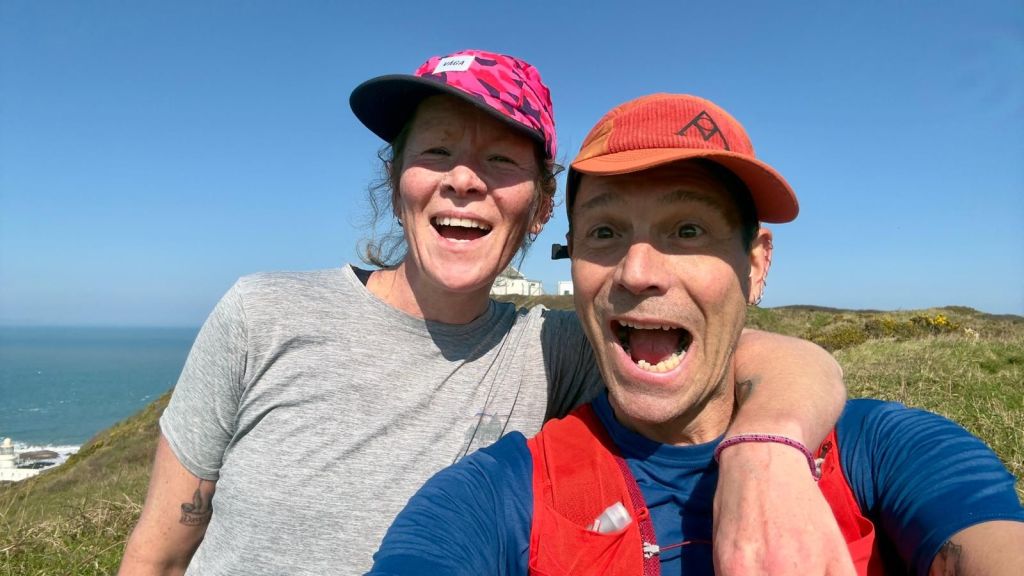
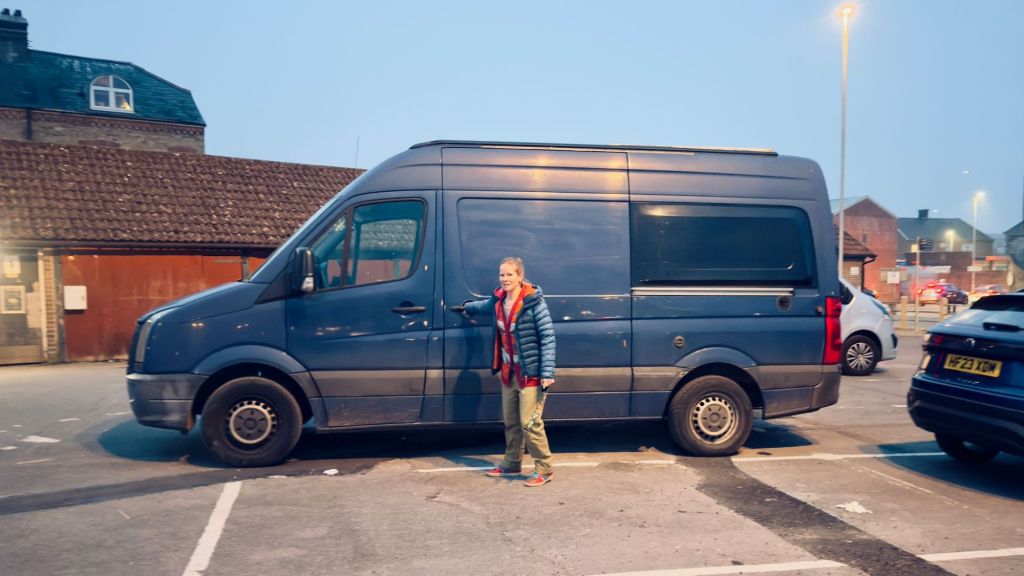
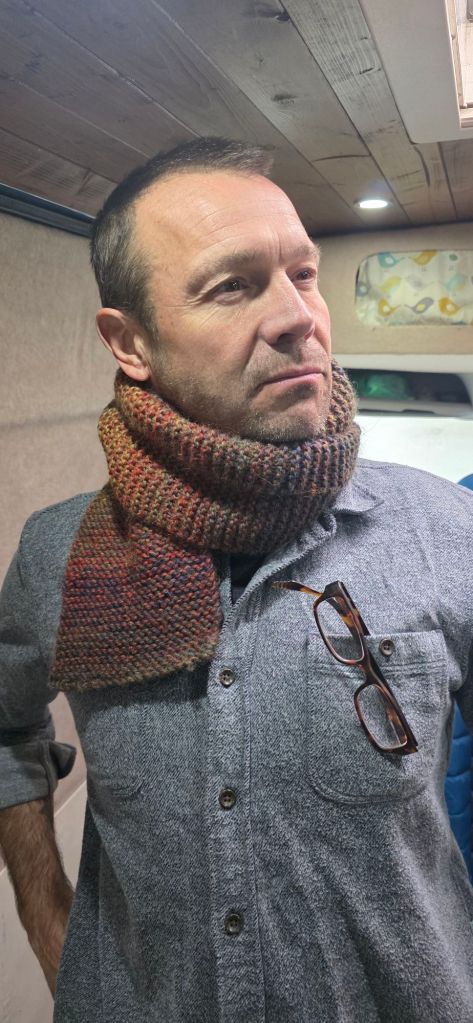
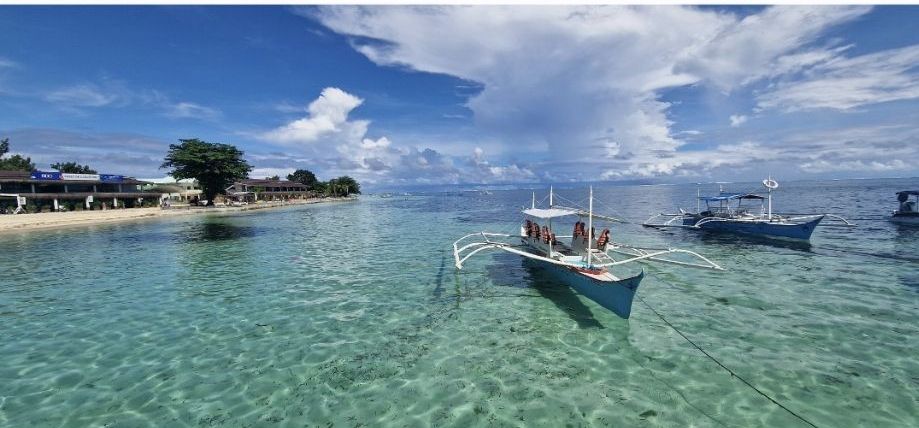
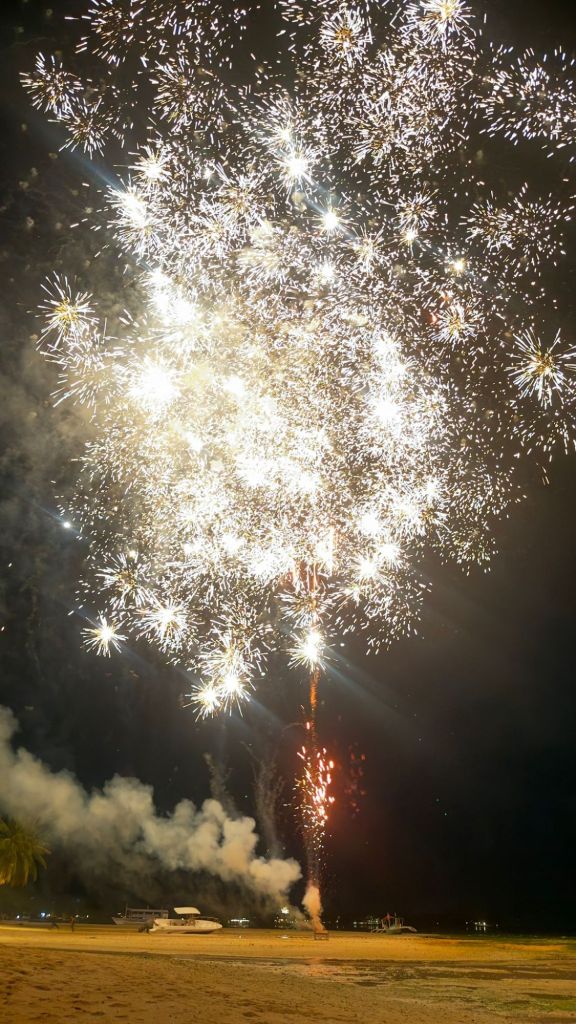
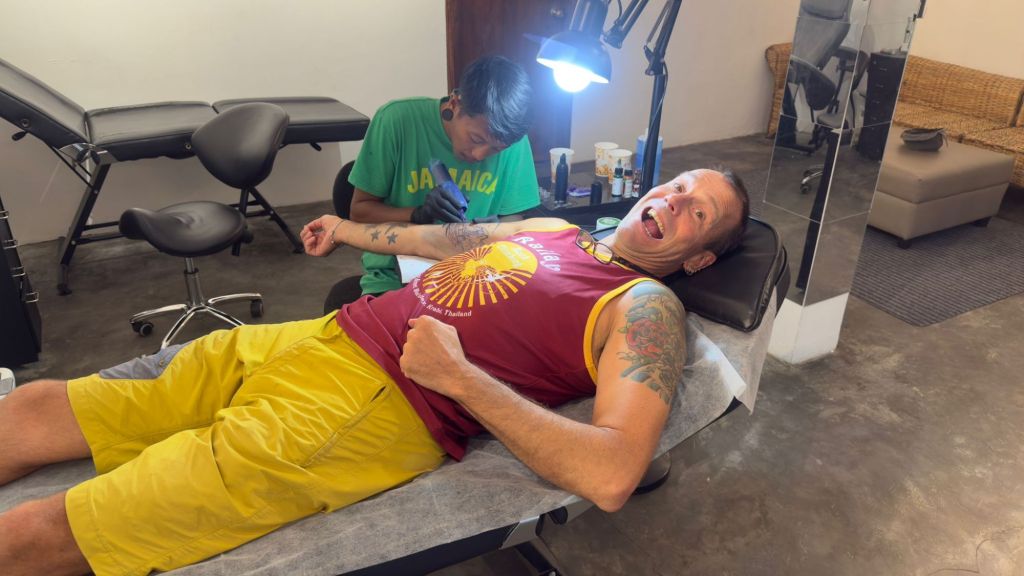
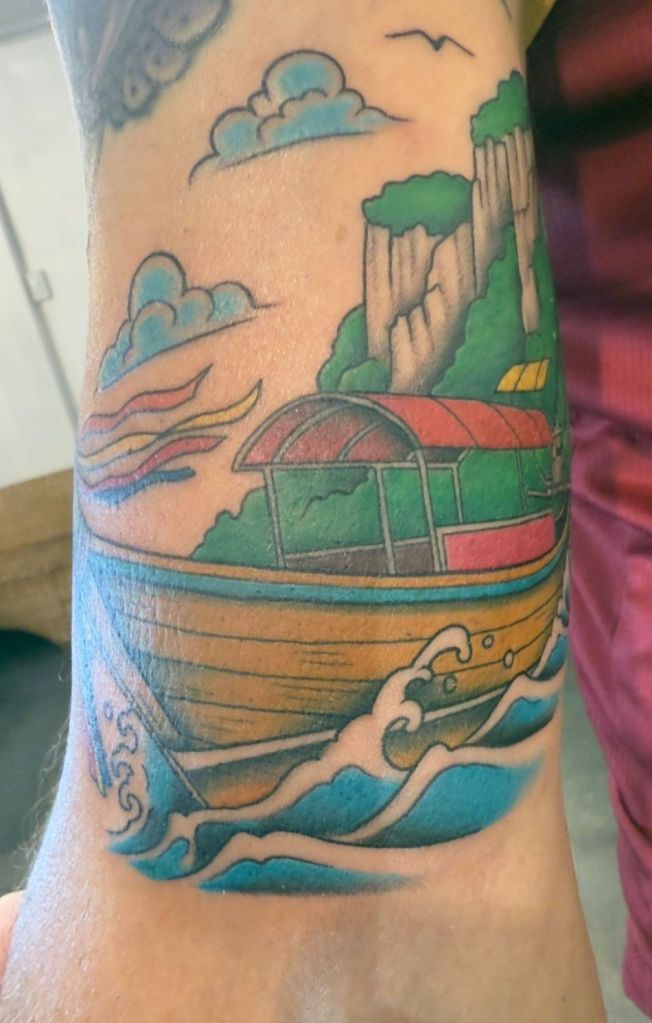
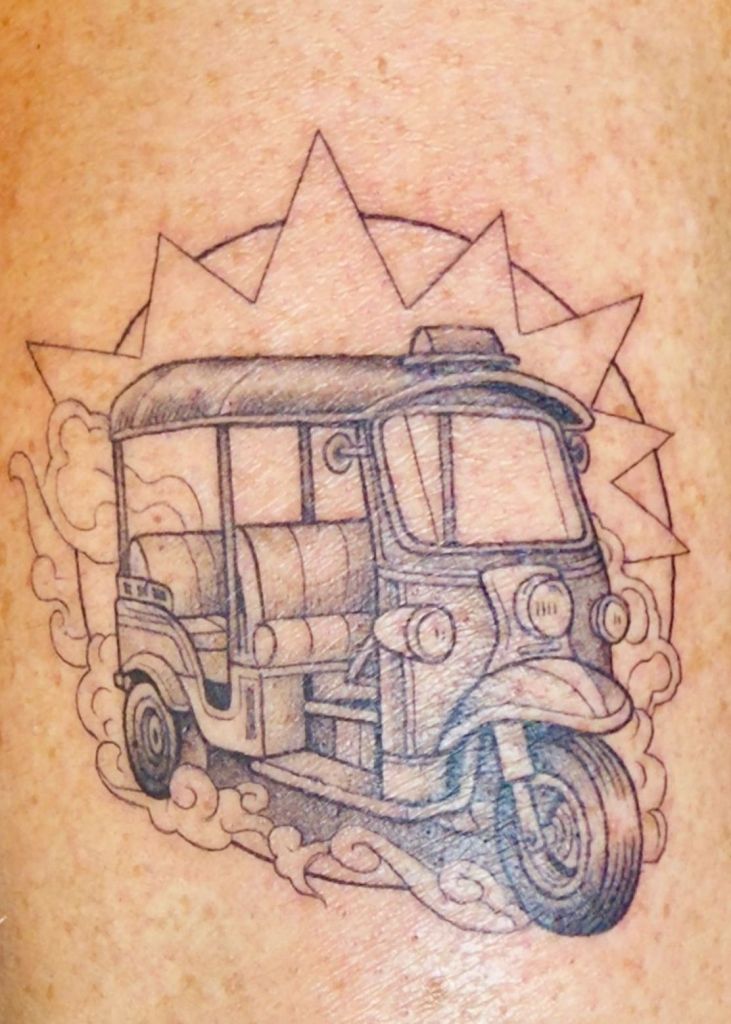
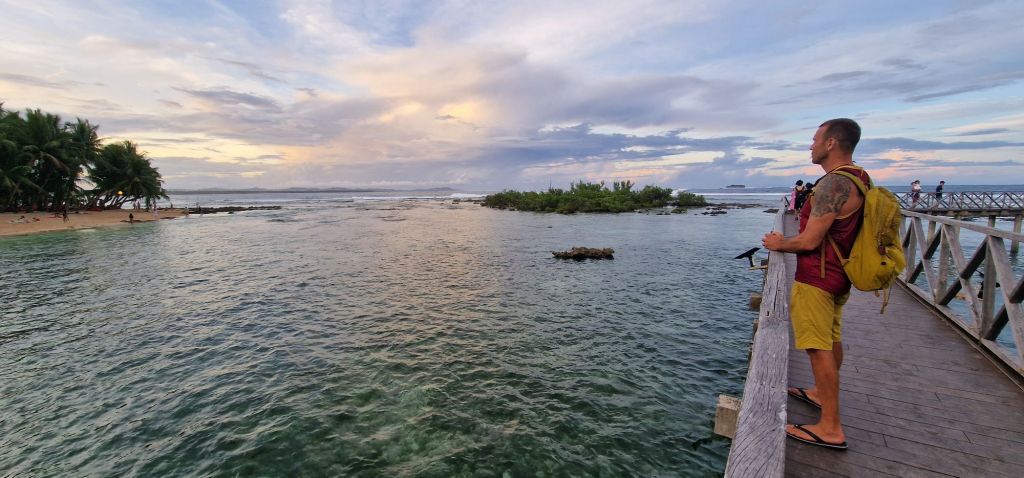
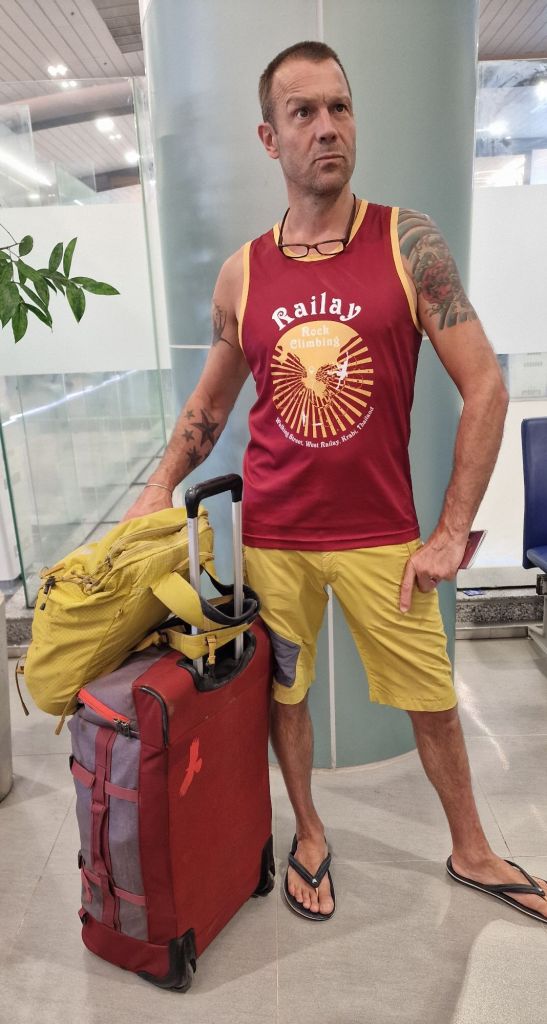
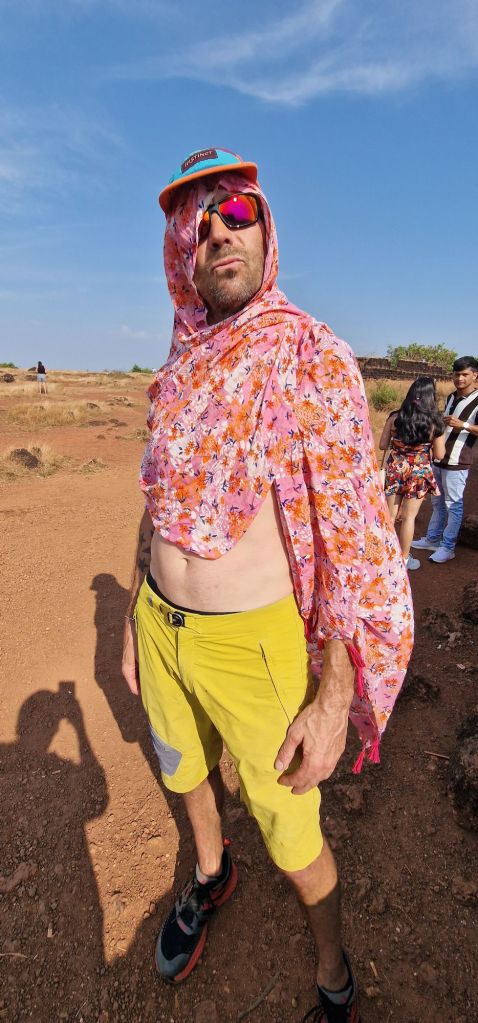
I made a wager with Jem about two months ago that by December he would be sporting a ‘wrap-around’ of some description, to great protests of, “as if I’d ever wear a wrap-around, I’m not a total hippy” etc. Lo and behold, this evening, Jem presents.
😂😂 Wrap-around
I think it’s just for domestic use 👀
We hear the weather is really awful at home, so apologies in advance for a report full of sunshine and joy.
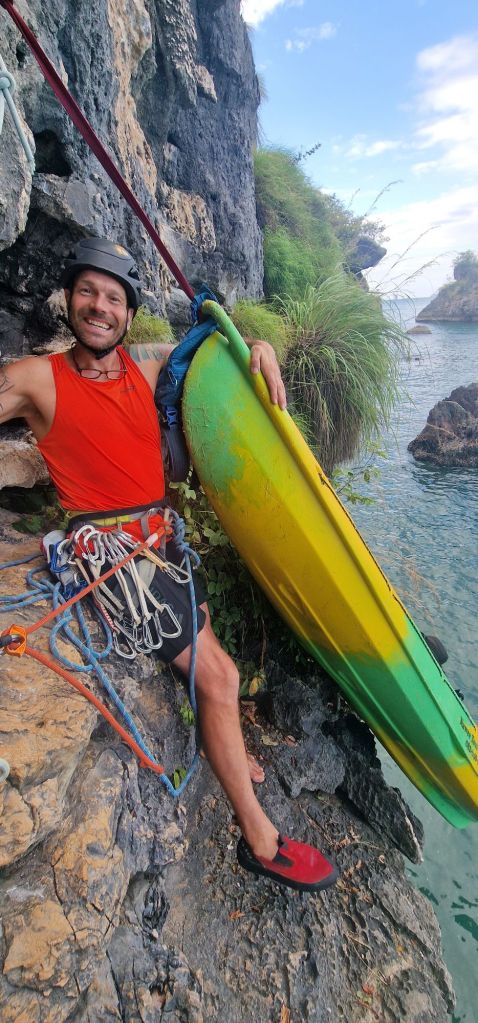
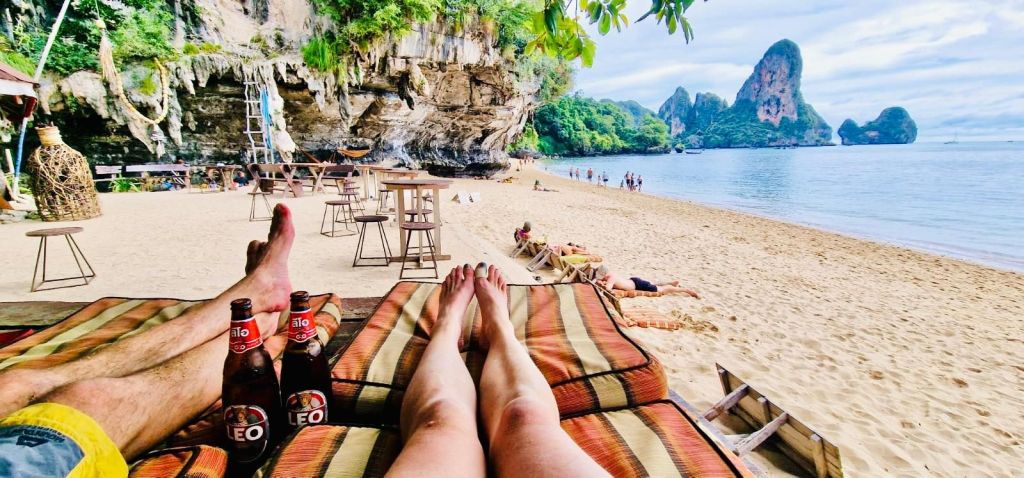
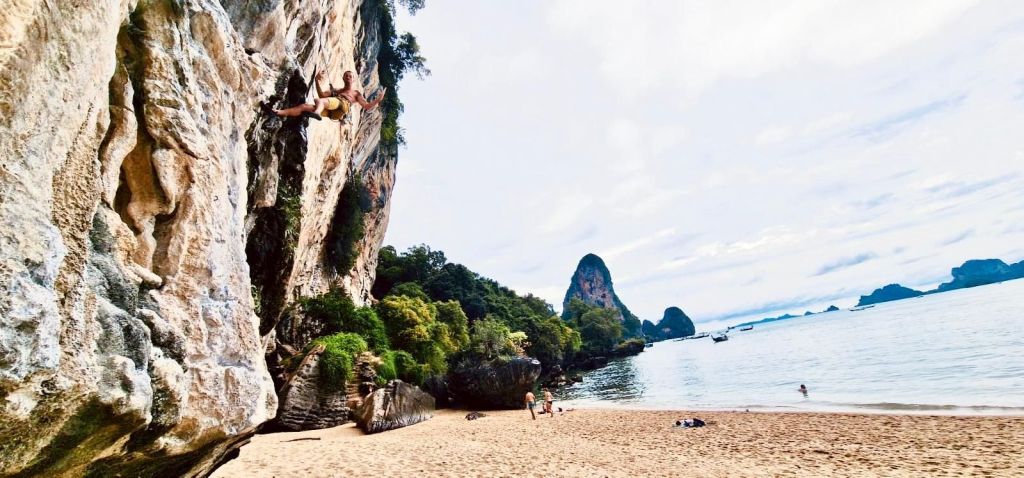
The last few days have been brilliant, mostly involving a 6.30am start, at the crag by 8am, and then in the bar by 4pm.
In the bar. That’s the climbing beyond
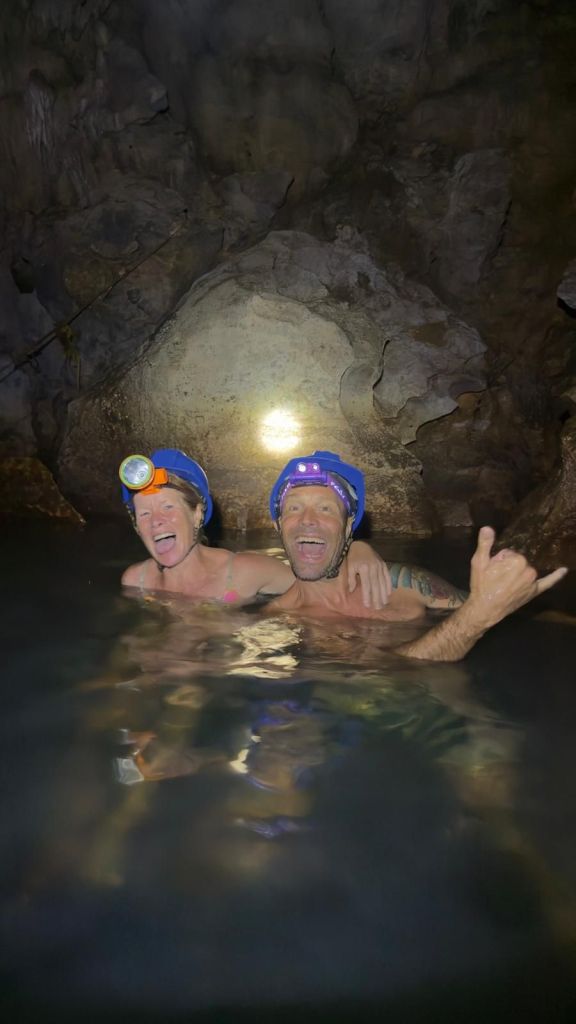
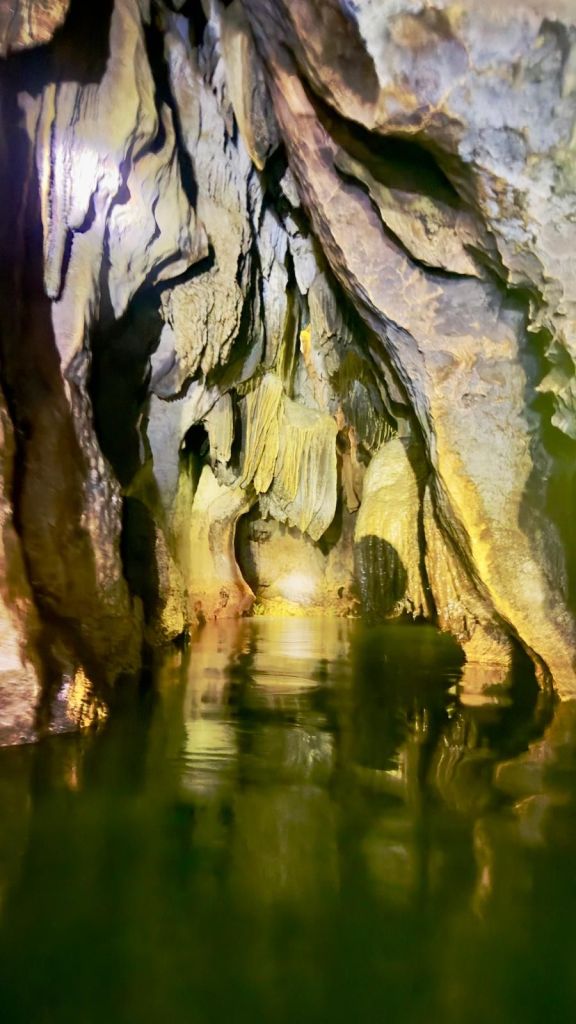
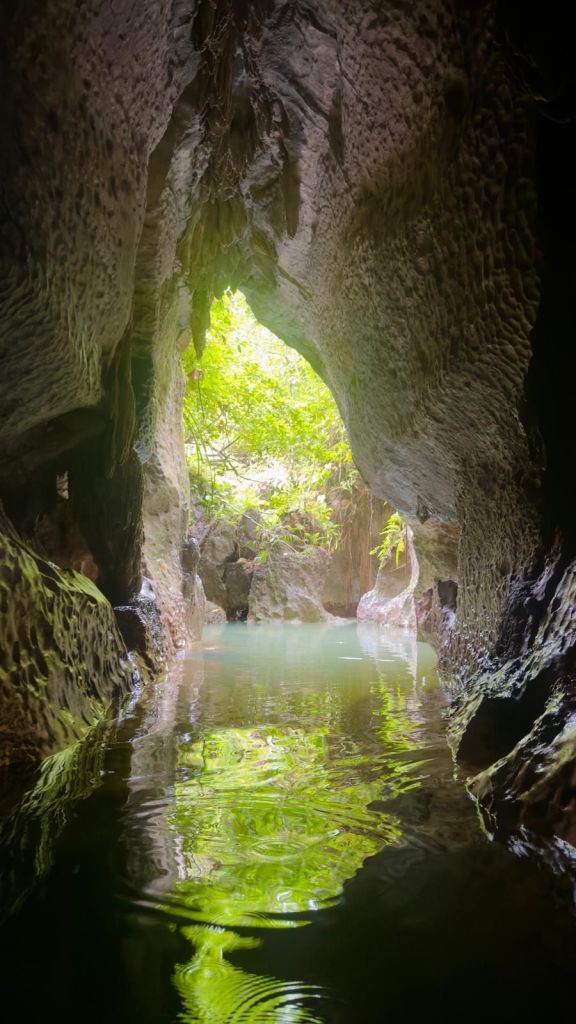
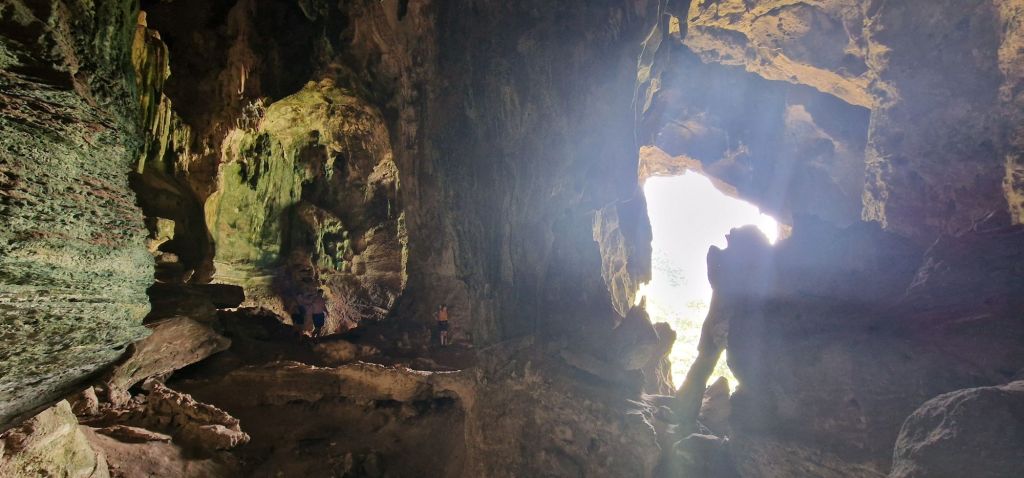
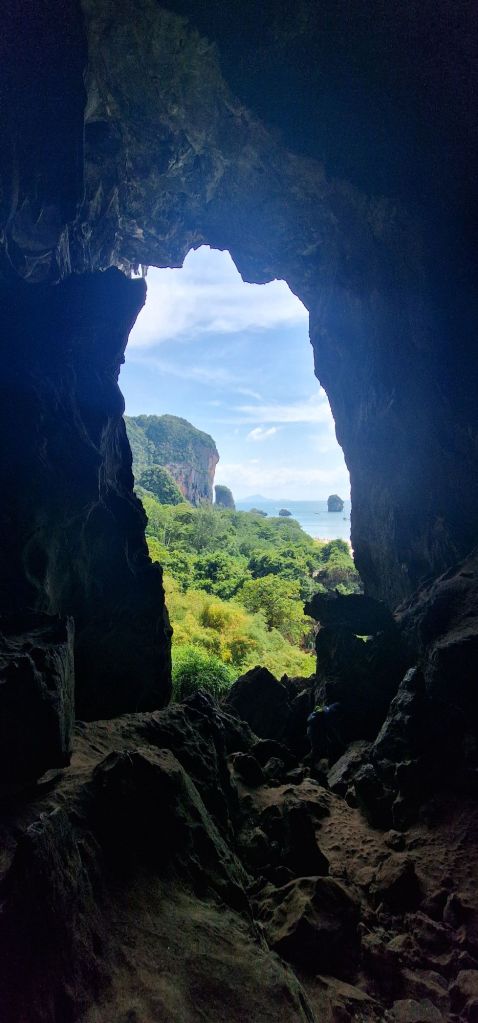
A couple of days ago, we went to a local lagoon; a very exciting expedition that involves some scrambling into the base of a crater.
Lagoon scenes
We have spent the last few days looking for a clipstick as the first bolts on the routes here are generally high. On day 3 of the search, we found a local climbing store, and the Thai guy inside told us they wouldn’t rent or sell us a stick, but we could have it for free, as well as a guide book, and to make a donation to the bolting fund at the end of our trip. He was such a dude 🌈 total restoration of faith in humankind!
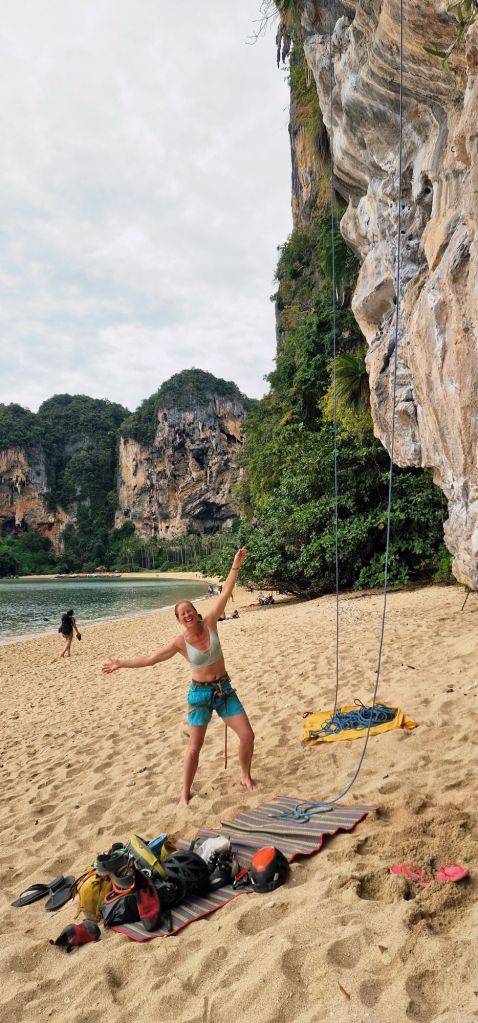
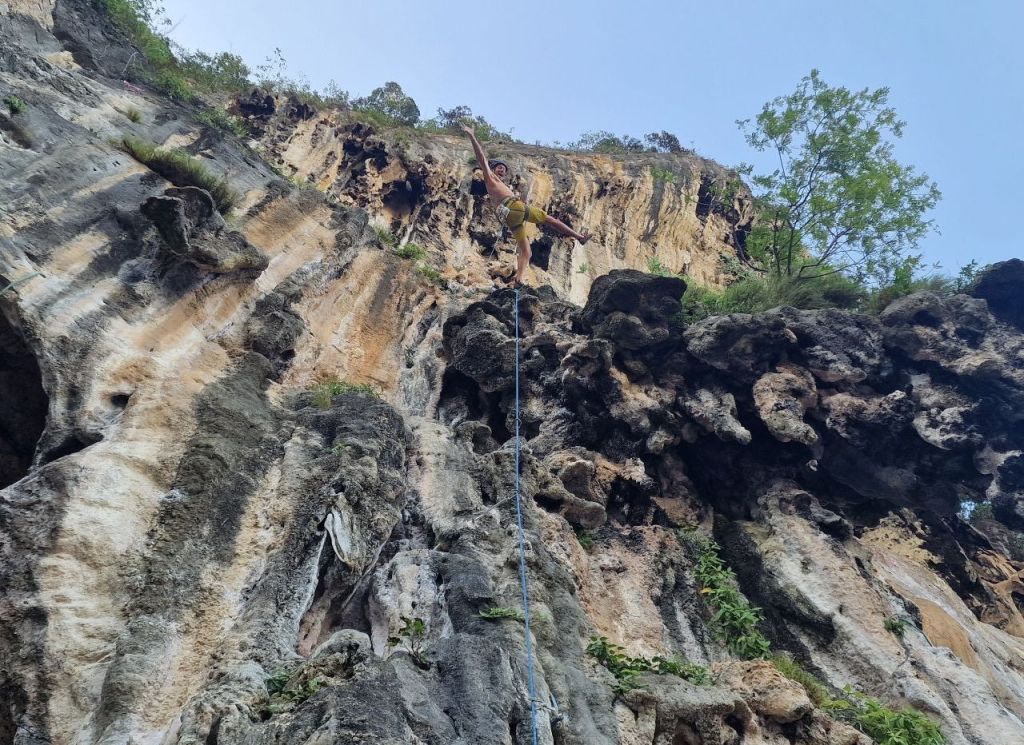
Climbing isn’t very interesting for most people, so without much explanation, here are some photos of stuff we’ve done:
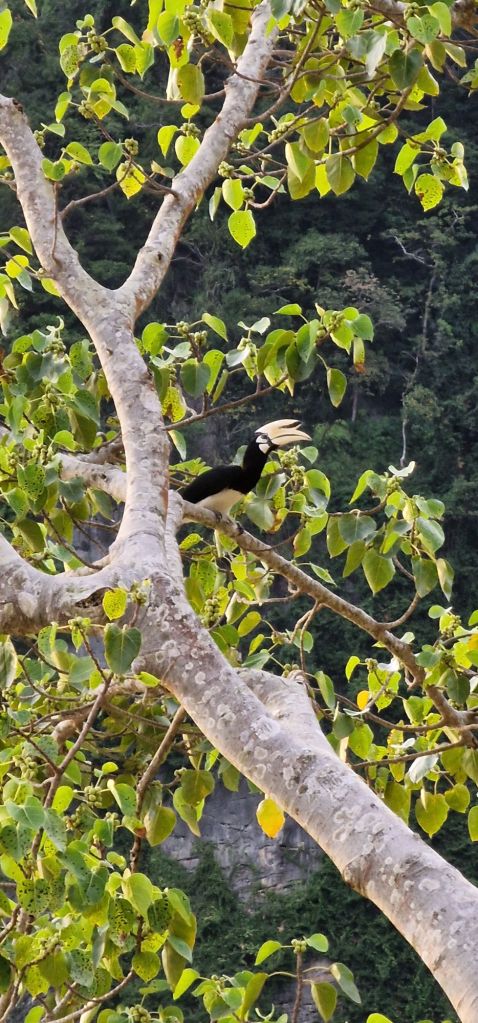
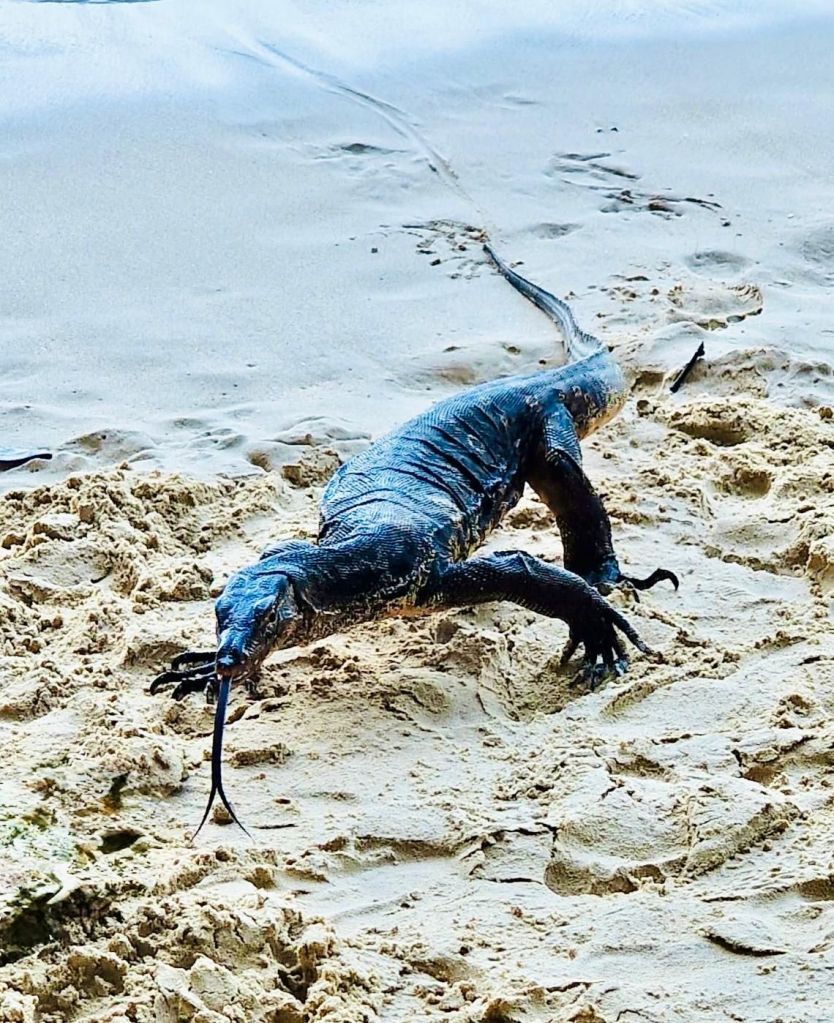
The climbing is really unbelievable, and we are both completely psyched out of our minds . Almost as unbelievable as when a 5-foot Monitor Lizard ran up the beach yesterday just inches from us… turns out he was just one of a benign local lizard gang who swan about looking hopefully for leftovers.
He looks scary but he was really quite nice
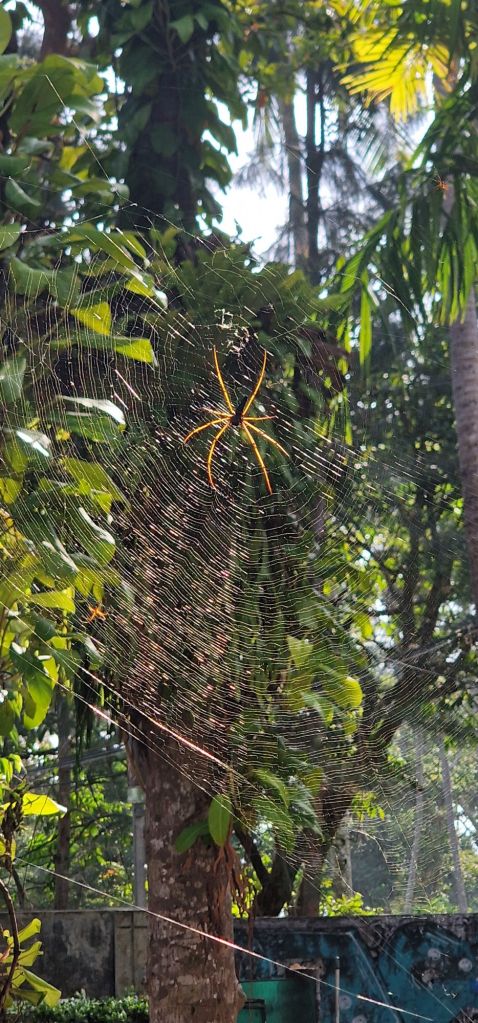
In other animal news, we saw some Golden Orb Weavers, who are from the VIP area of the spider world, and make amazing webs that would be really terrifying to walk into at night.
Flashback to Indiana JonesThis one was as big as my hand. They don’t care for humans and are not particularly dangerous
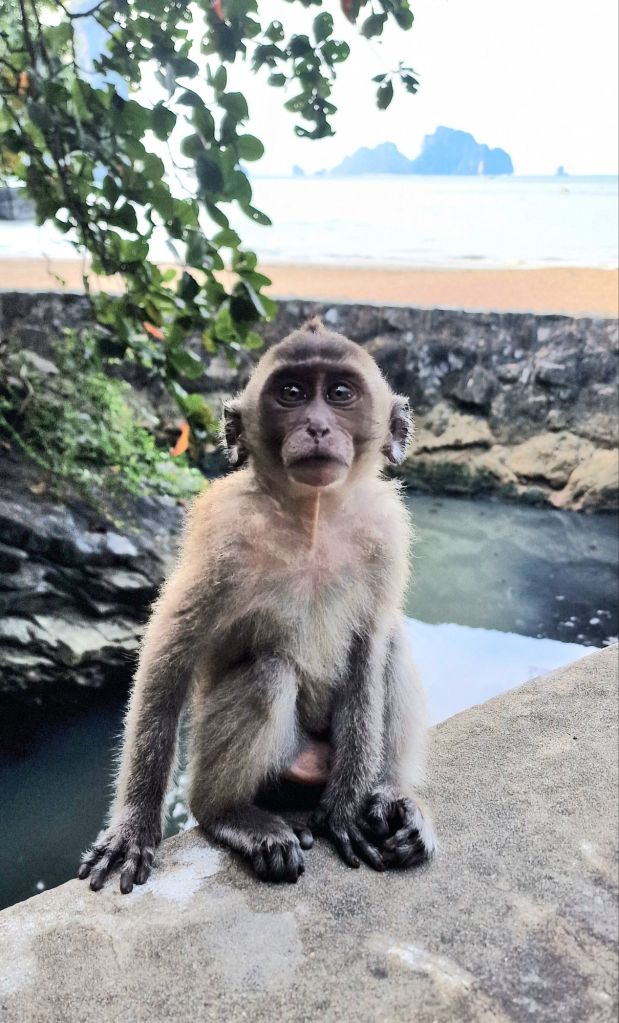
And here are some monkeys
There is not too much more to report really. Miss you all at home, massive lobes to everyone! ❤️ 💙 💜
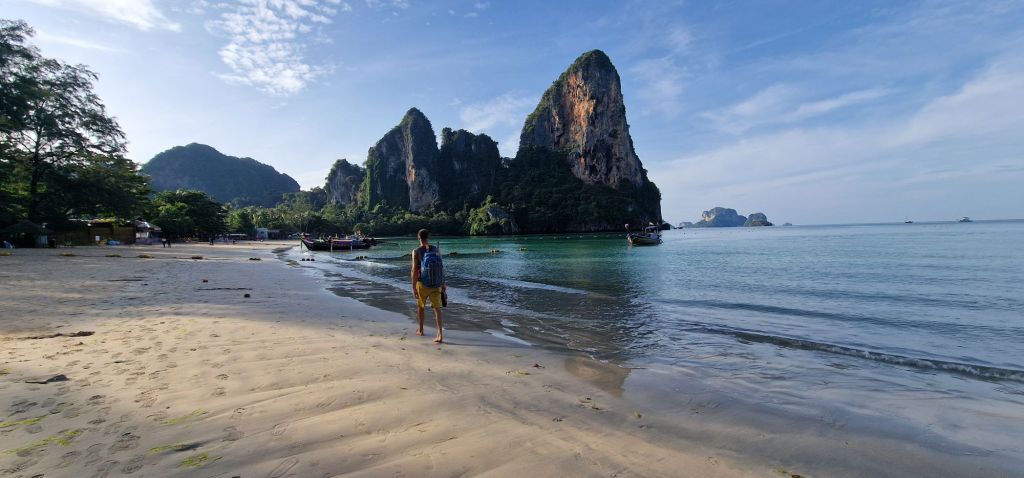
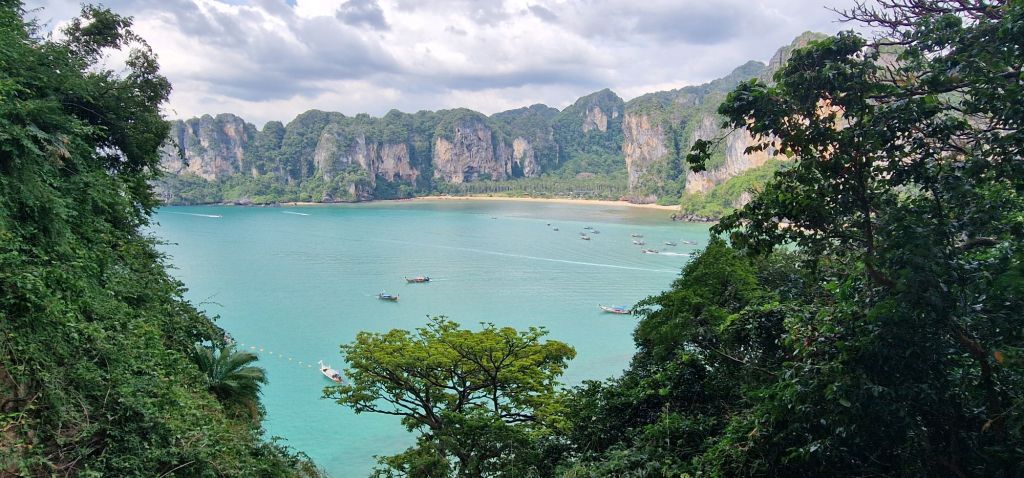
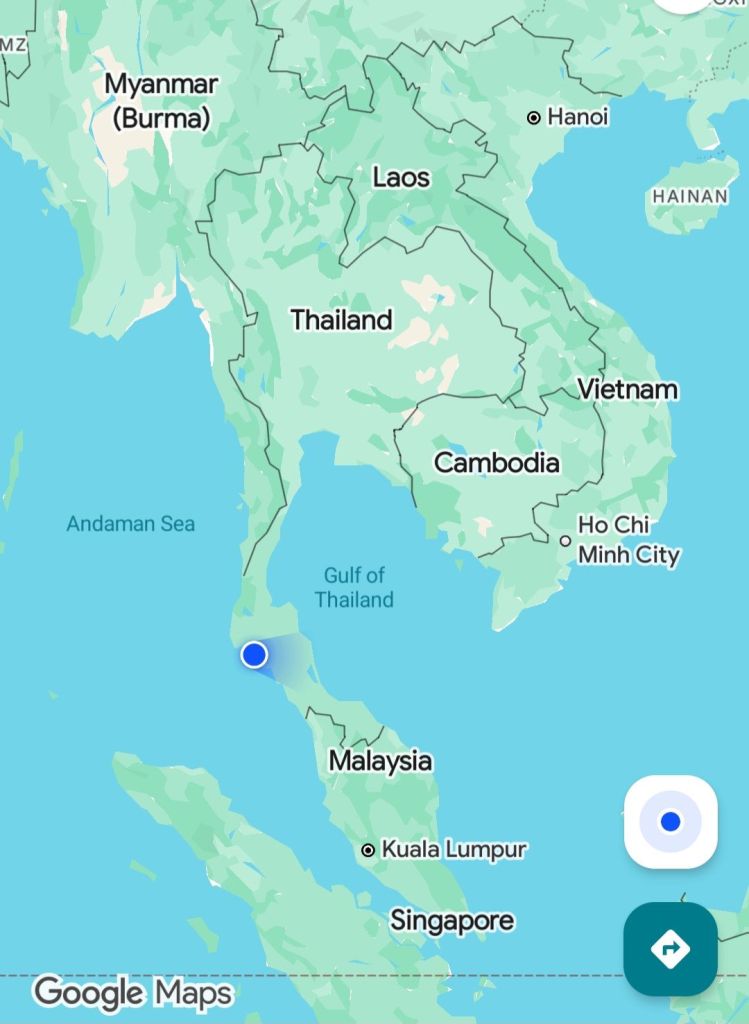
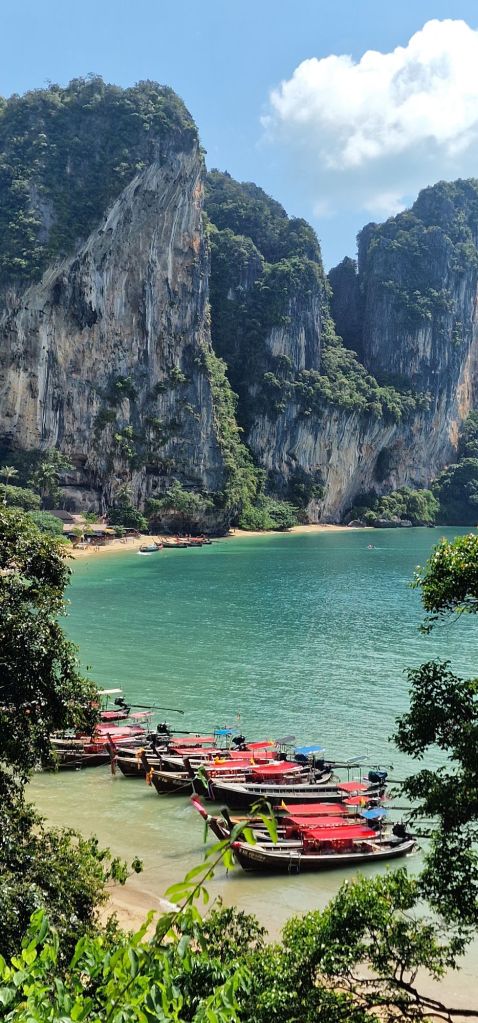
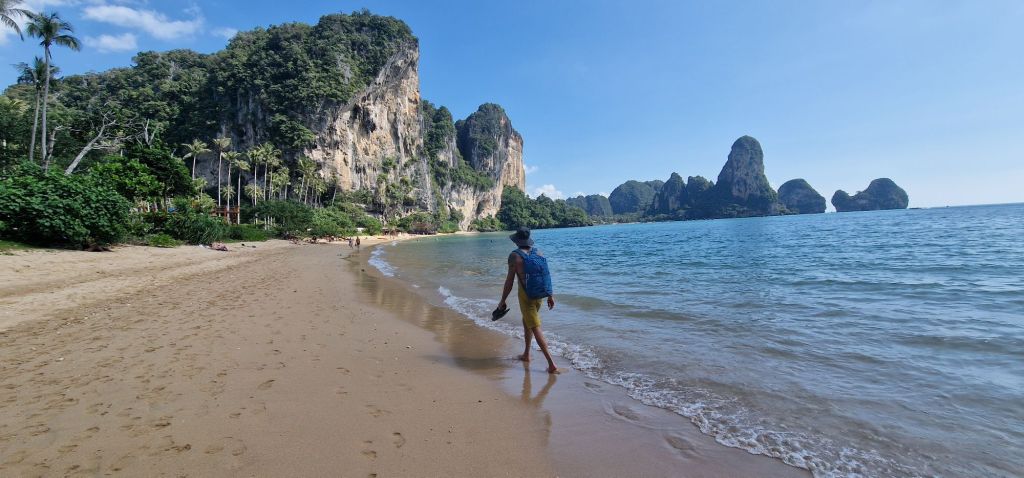
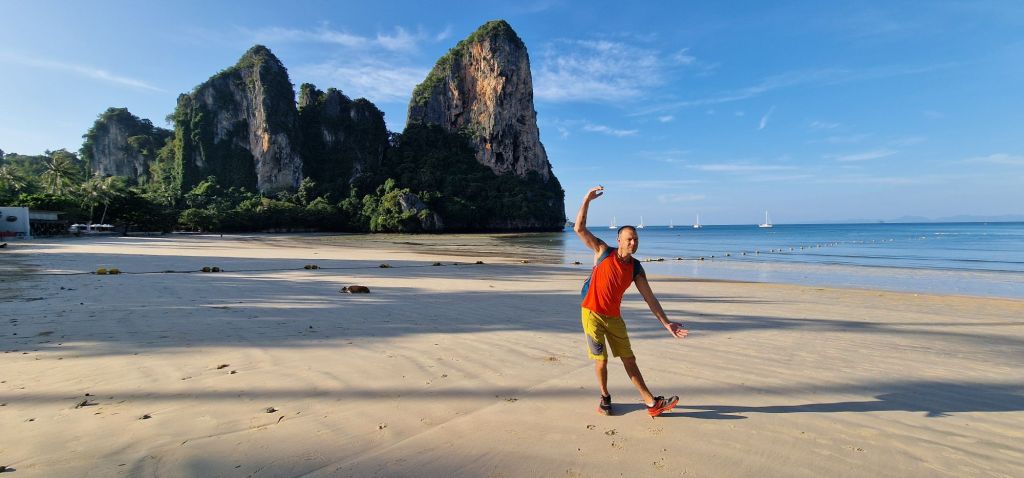
‘Sawasdee Ka’ from Tonsai, a semi-isolated jungle and coastal community surrounded by crystal-blue seas, and towering cliffs of perfectly-formed, mostly overhanging limestone. It is the mecca of winter climbing destinations; world-class routes, hut living, delicious Thai food, and absolute peace.
Tonsai is mainly full of climbers, with some backpackers and a few families. Not being an official ‘village’, it has always felt quite makeshift, but on this trip it has really established itself with swankier accommodation and paved roads.
Check dis. Official rad pad
It was a little intimidating arriving in Tonsai as the climbing grades are pretty tough, and when I last came in 2014 with our lad Padlogdog, we were going pretty well. Moreover, Jem and I have been seriously dedicating our time to sampling all of the national dishes and beers on our journey, and with new enhanced waistlines, the prospect of notable success seems improbable.
The neighbouring town, Railay, accessed via short walk through the jungle, is connected to real life and is much more touristy and very busy. Luckily for us, there is easier climbing there!
View of Tonsai beach from Fire Wall
Yesterday, we went for a Thai massage, where basically you get the crap pummelled out of you for an hour, and about 45 mins in, you are begging them for mercy. Jem cracked so much it was like listening to someone stand on a chicken carcass. Today, we feel like goddamn heroes and my tendonitis has vanished. Climbing is going well, and we are enjoying it so much.
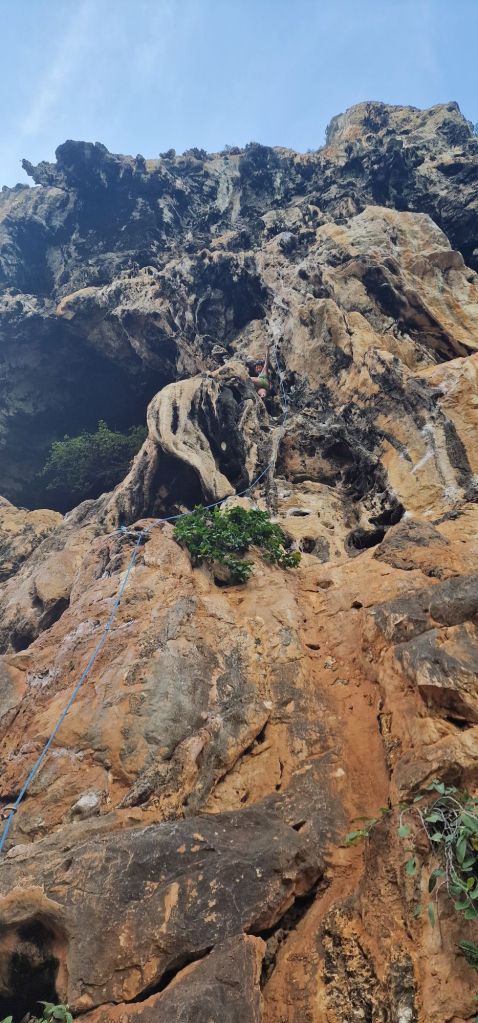
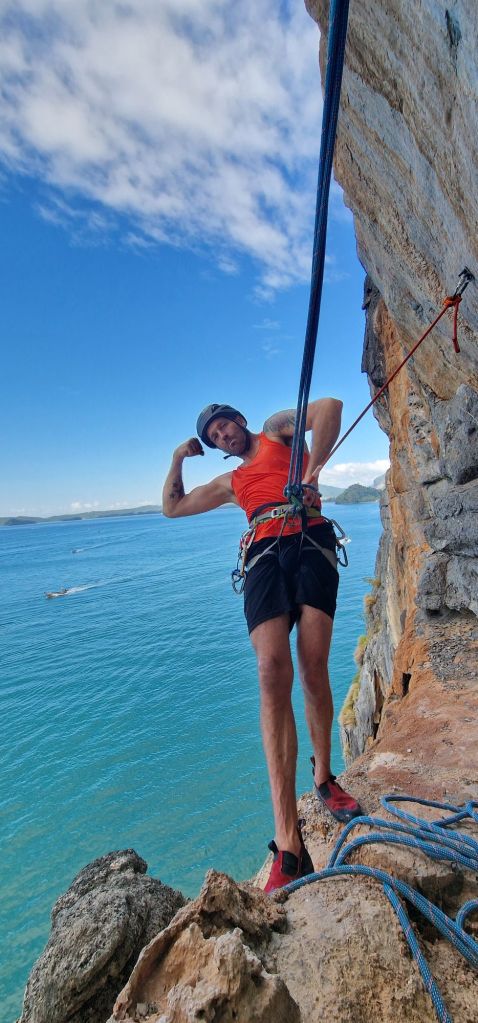
We started the first day on the uber-classic Groove Tube, a 3-star 6a, which has a very unique feature before the first boltThere he is! There was a lot of gruntingWe’ve done some epic routes, most of which involve executing some acrobatics around a big stalagtite. It is funny to hear Jem exclaim: “THAT WAS THE BEST ROUTE I’VE EVER DONE” after every route he does.The climbing is a dreamThe 100pc humidity is pretty rough on the hands!
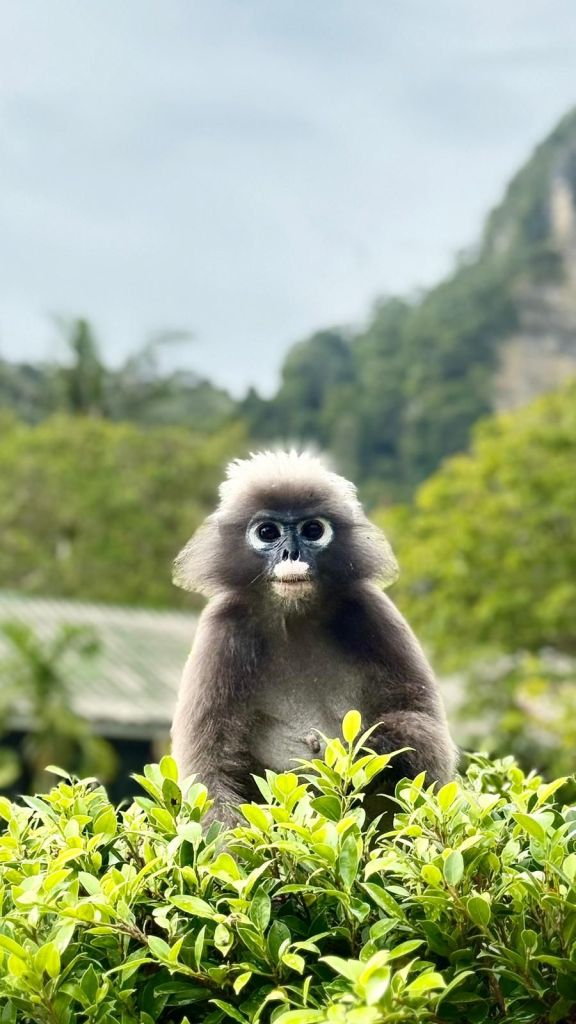
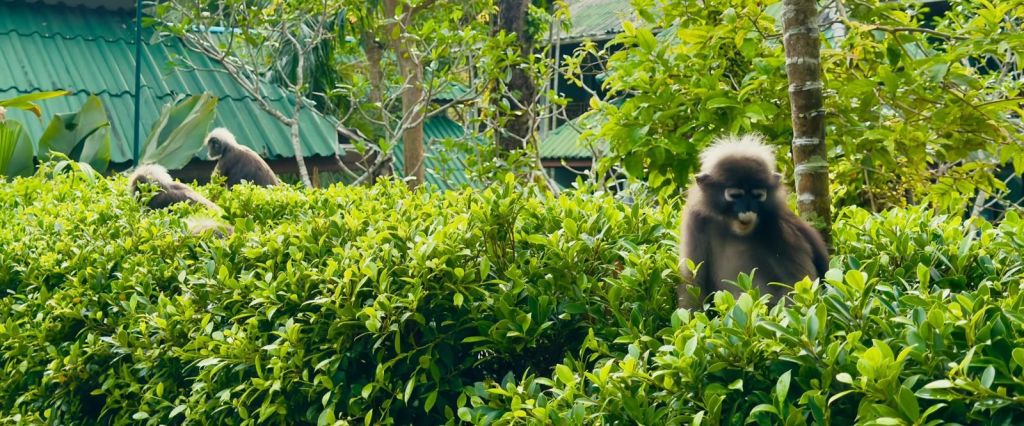
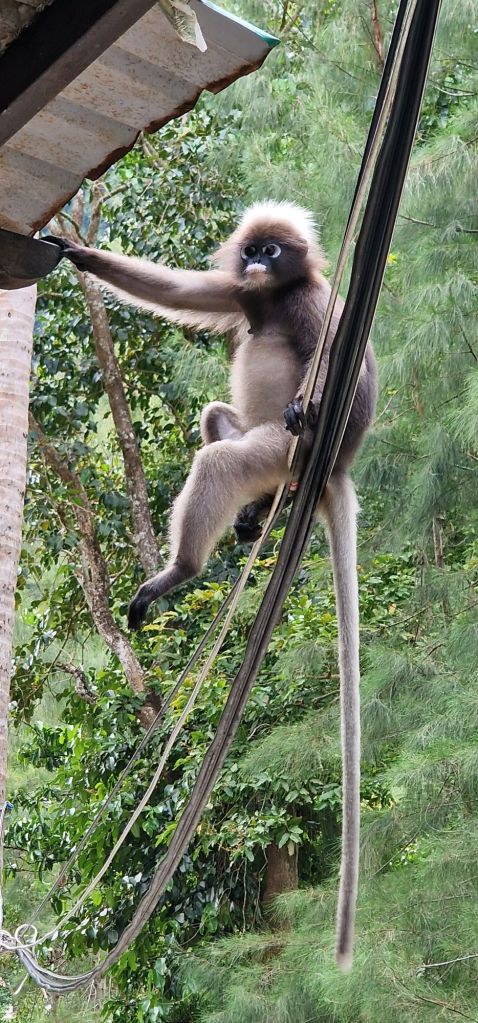
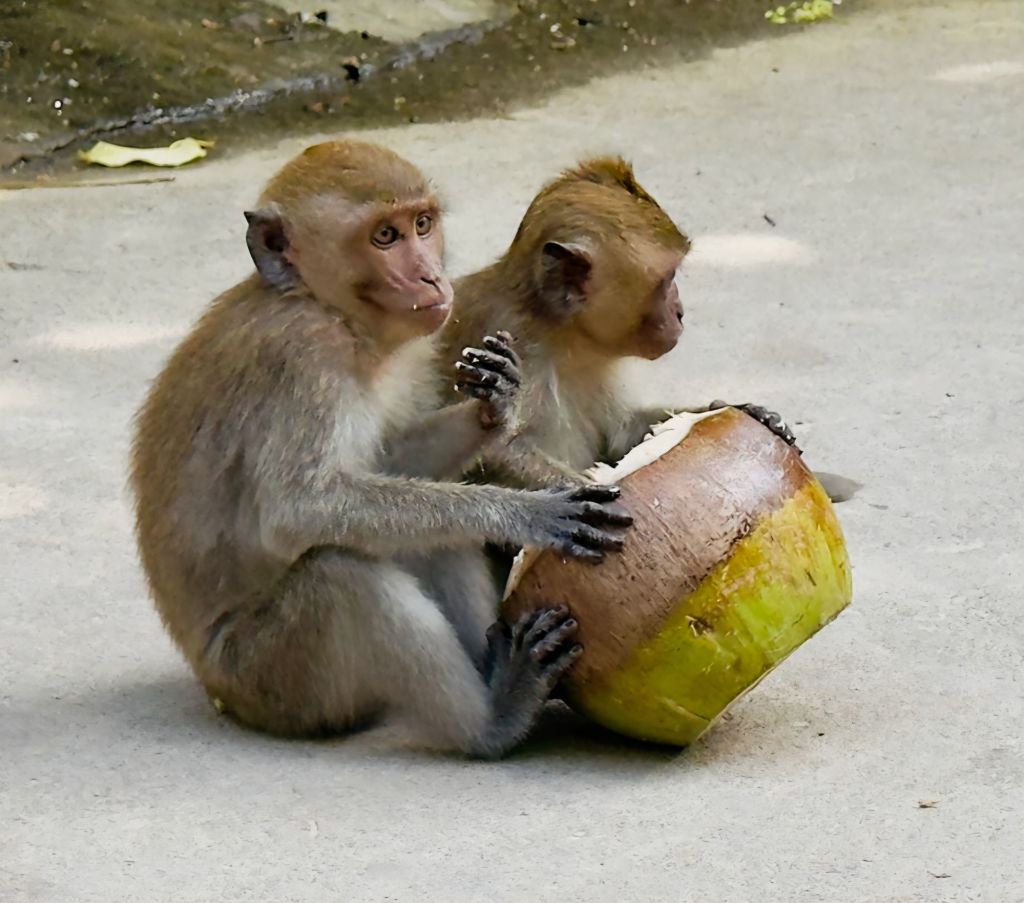
In monkey news, here are our local genre of ape, who are always hiding around a corner and jumping up and down on our roof.
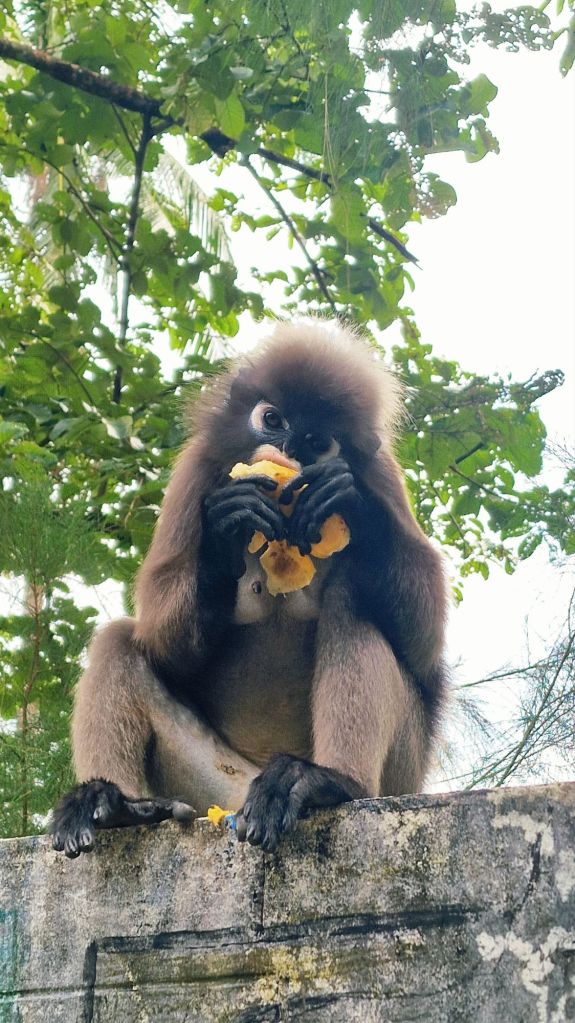
This guy was hanging out by our hut last night. It’s a Dusky (or Spectacled) Langur and they seem pretty friendlyThese Long-Tailed Macaques won the cute contest
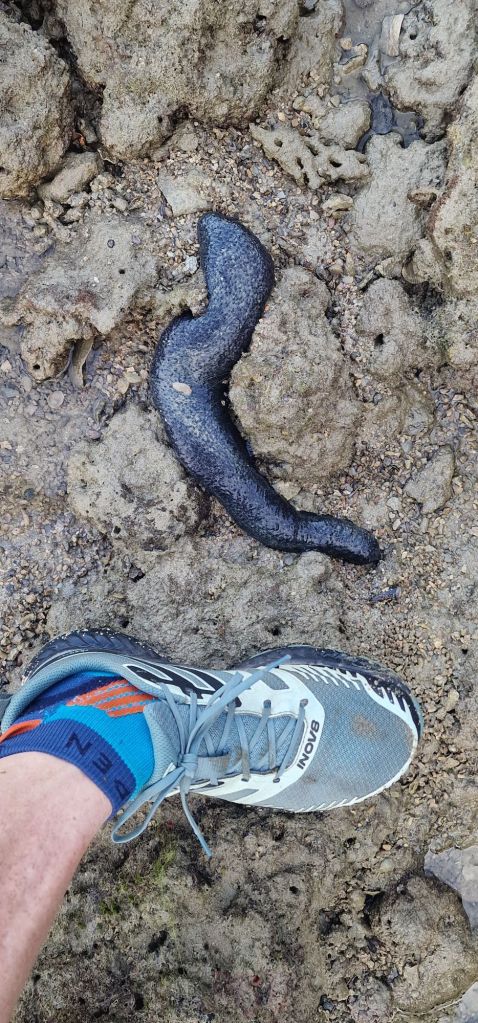
There are also weird slugs on the beach. A Black Sea Cucumber, apparently.
Foot for scale. People eat these in Asia as a delicacy
The Thais are really lovely people. Everyone here is smiling and it is really infectious. We haven’t been approached once by anyone wanting business, and the climbing community is super friendly. A dream destination indeed.
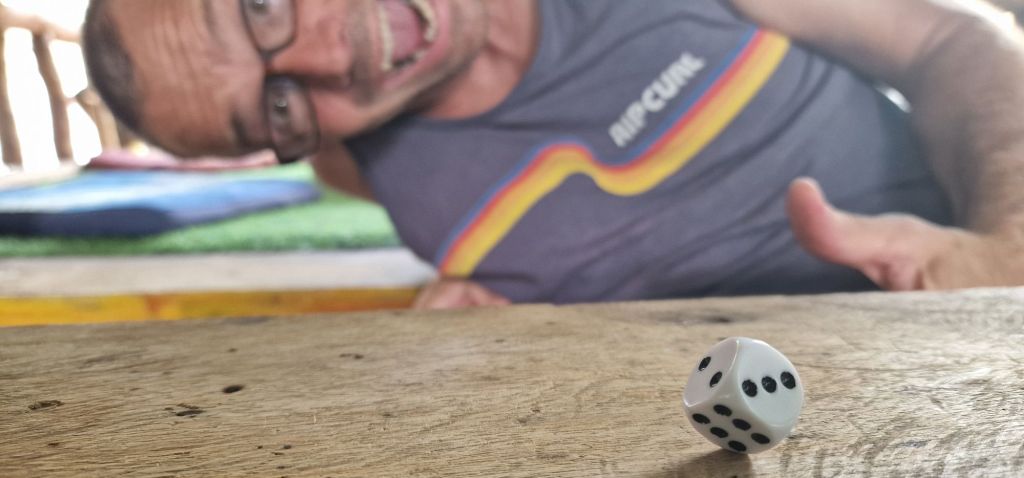
Final note. So this happened. Jem rolled a dice on a flat surface, and it landed on its corner. He is the messiah. Mad.
This is the plane we have been waiting two days for…
So after 12 hours of waiting at Goa airport, our rescheduled flight was finally cancelled. Cue massive scramble to book new flights… the last ones left, which we had to sell some organs to buy, took us to Thailand via United Arab Emirates with a 16-hour layover.
We are now in Dubai, surrounded by sand, a few days behind schedule, and about to board our flight to Thailand. Had a right grilling from customs as we looked like drug traffickers, apparently.
The heat has been turned up to 11, more than 30 degrees in the afternoon. Here, Jem channels his best Lawrence of Arabia
During the major disruption at UK airports in July, when a radar issue grounded 150 flights and caused chaos country-wide, I remember feeling relieved and lucky that I’d never been embroiled in such a drama.
Fast forward four months. India’s main carrier, IndiGo, has been in complete meltdown for the last few days following new rules introduced around ‘flight duty time limitations’, reducing the hours pilots and crew can work. Despite months to prepare for the new legislation, IndiGo has been crippled, and just yesterday, up to 500 flights were cancelled. Our flight to Mumbai was delayed by several hours, thus missing our connection to Thailand.
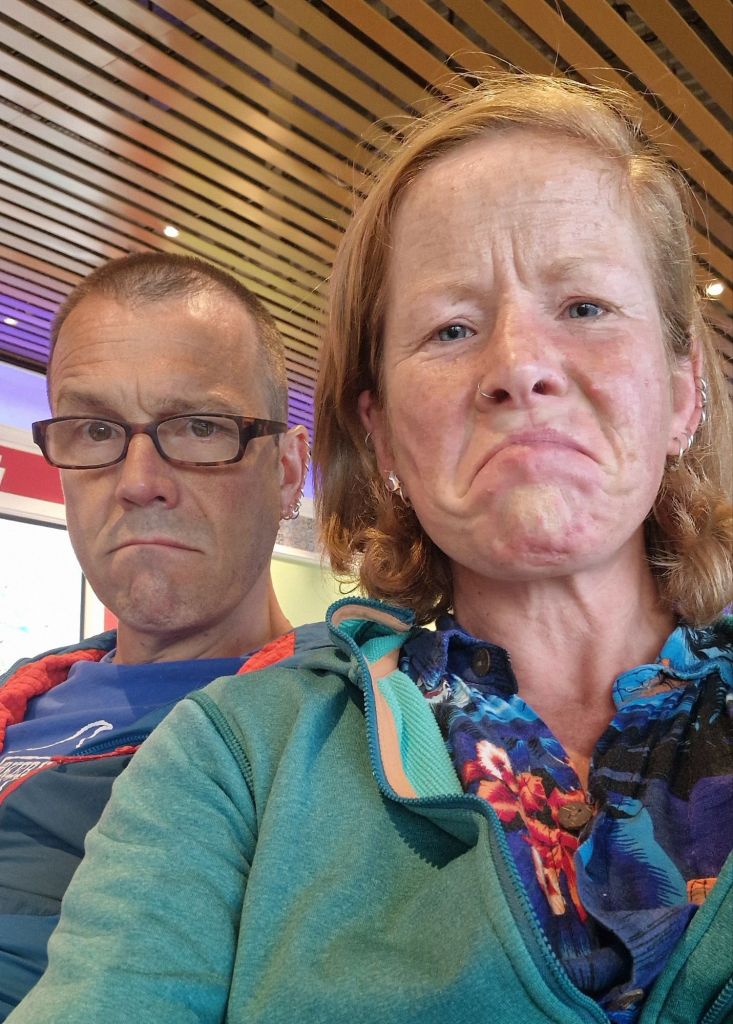
I can feel myself getting older in this airport
We arrived at the airport in Goa yesterday to scenes of absolute bedlam. Huge angry mobs; pushing, fist waving, and full-blown shouting matches. Indians have no concept of queuing or the meaning of personal space, which can come across as rather rude, and last night threatened to infringe on our delicate English sensibilities. Jem calmly explained to one fraught and boisterous woman about the efficiency benefits of a ‘queueing system’, which I don’t think quite hit the target.
When we eventually got to the front of the furious crowd, the poor staff member (and her manager behind with his head in his hands) were getting screamed at from every angle as they tried to change our flights. A bad day in the office indeed.
Flights are being delayed and cancelled at the last minute, and 10 hours after arriving at the airport, we are still waiting for our new flight to take off. It is already delayed by a few hours, threatening to miss our new connection in Bengaluru. Apparently, the backlog will take at least a week to clear.
The last few days in Goa have been quite relaxing, with some lovely meals and an adventure to Panaji, the capital, an hour and a half away.
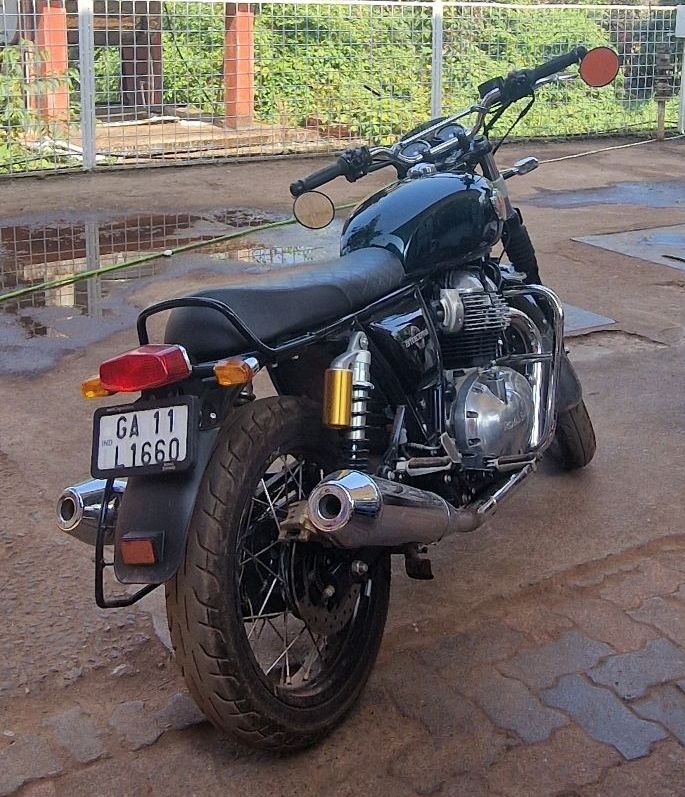
It’s quite a sexy bike I suppose, but the novelty wears off after 2 minutes in Indian rush hour
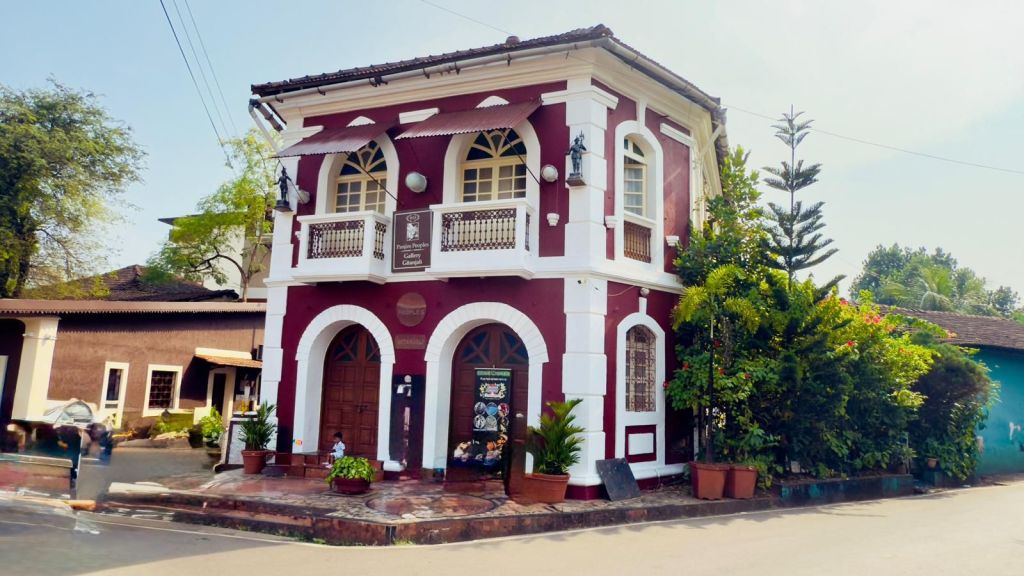
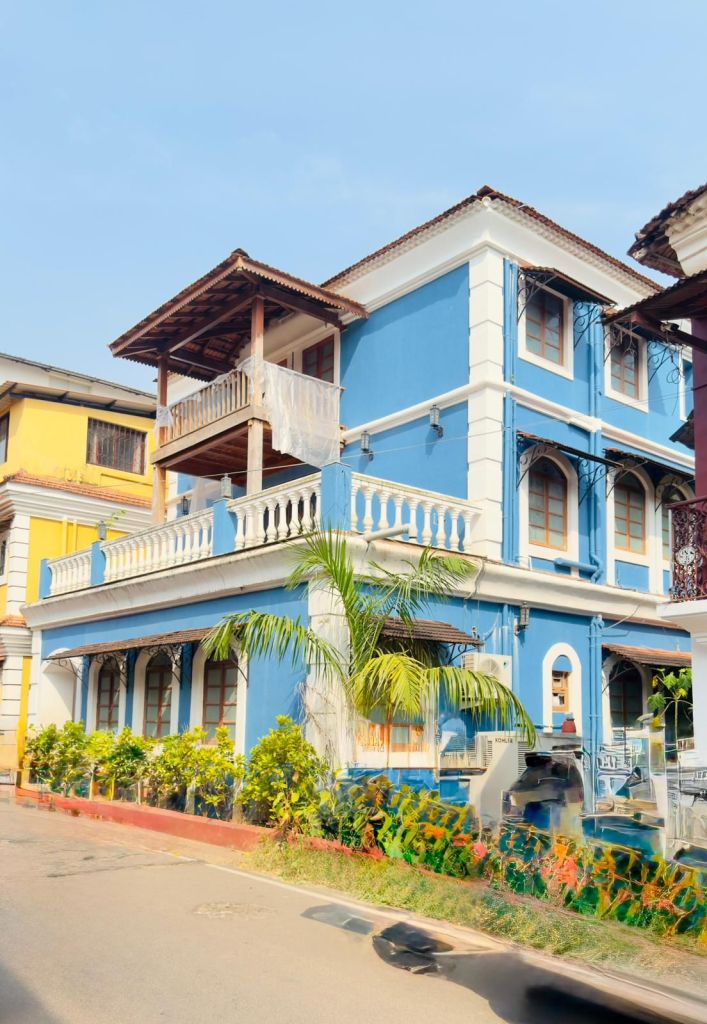
A white-knuckle ride indeed on the back of Jem’s rental Royal Enfield Interceptor. I shall not go into details, but we got home safe, just about. Our main aim was to see the colonial quarter, which hosts original Portuguese-style architecture.
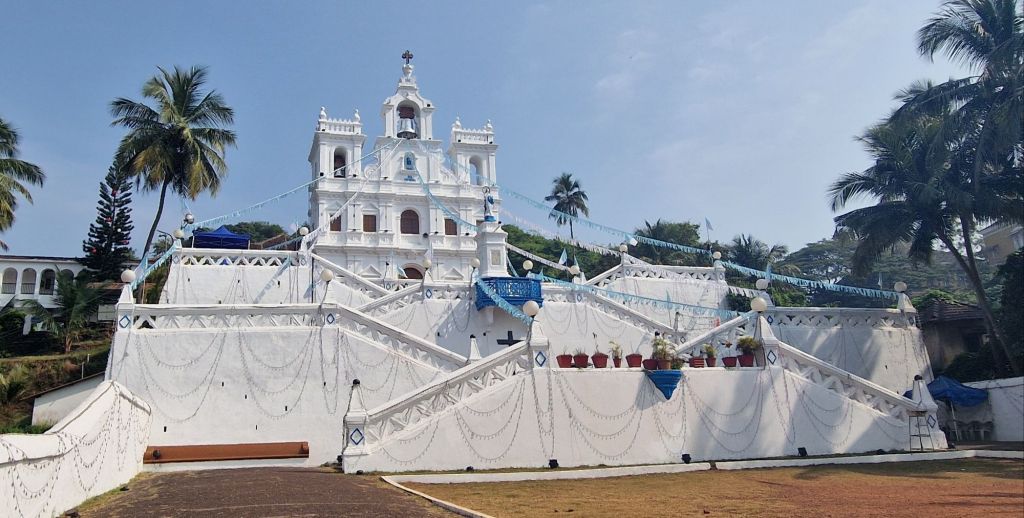
Our Lady of the Immaculate Conception Church. The colonial Portuguese Baroque style church was first built in 1541 as a chapel and replaced by a larger church in the 1600s as part of Portuguese Goa’s religious expansionThe Church conducts Mass every day in English, Konkani, and Portuguese
The links between Goans and Portuguese are strong; Goans can get a Portuguese passport if they were born in Goa before 1961 or if they are a direct descendant. There are shared words between Portuguese and the local language Konkani, including surnames, as well as continuing cultural and diplomatic exchanges.
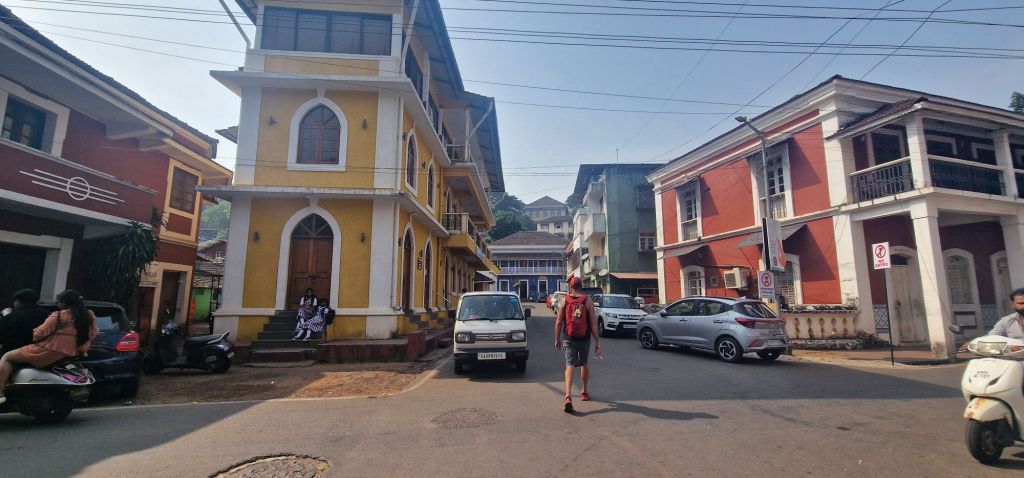
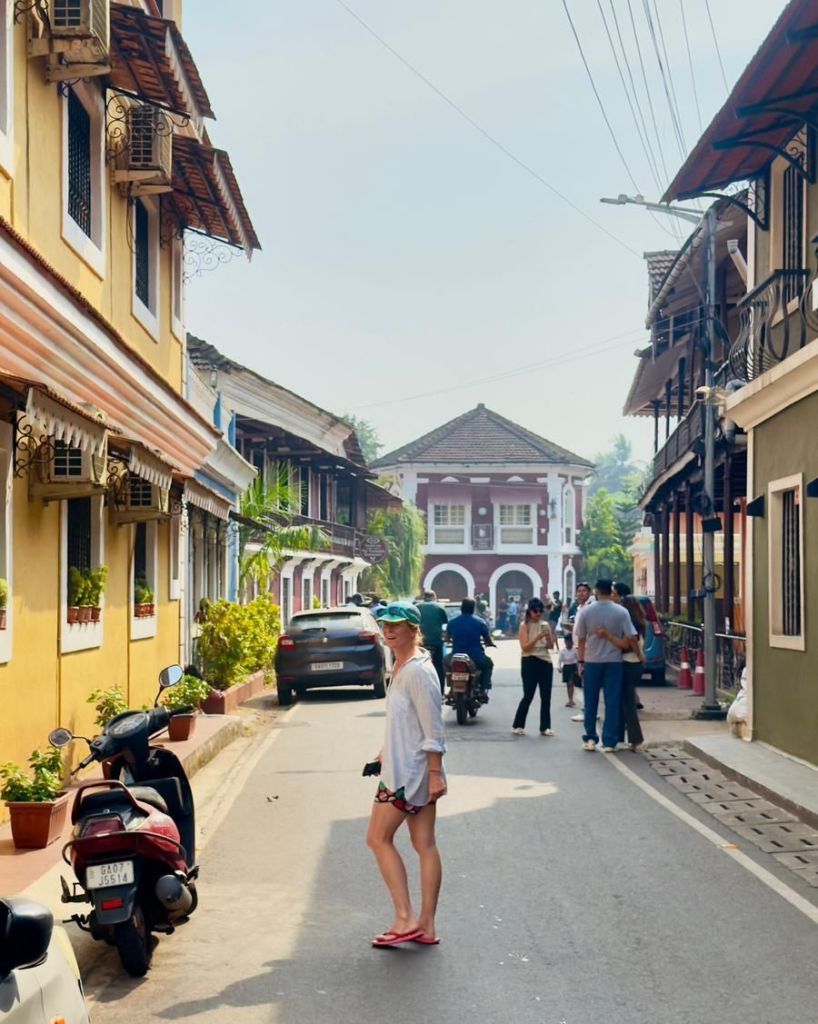
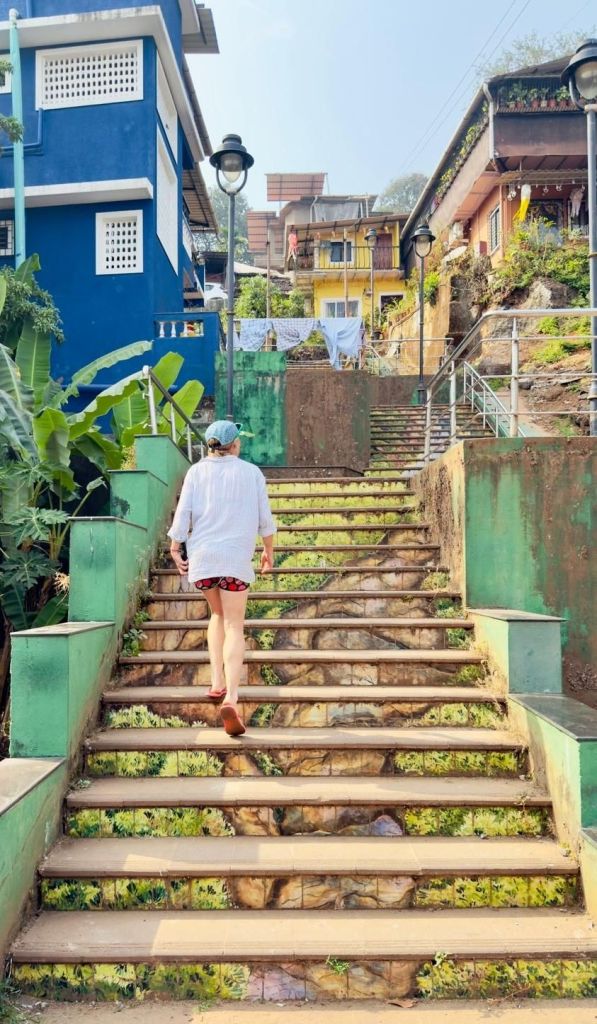
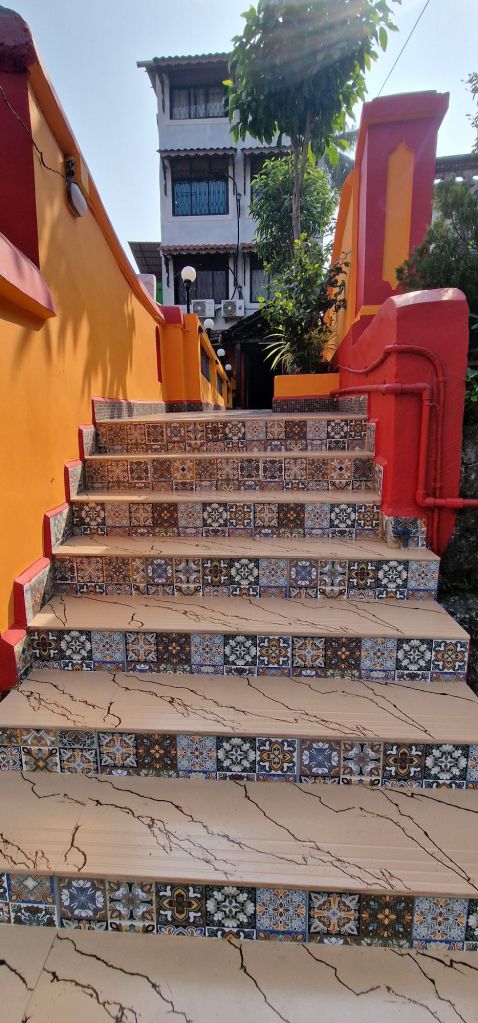
The neighbourhood Fountainhas, once a colonial residential area, is very beautiful and well-maintainedHurrah for common sense. The irony of this photograph is not lost on us 👀
Finally, as a resume on India, we have not particularly loved it. Even in Goa – which sells itself on its laid back, international, and ‘good vibes’ culture – you can’t sit on the beach for five minutes without being pestered by aggressive hawkers selling henna tattoos, anklets, sarongs, ear cleaning, massages, sun glasses, trinkets and souvenirs. Similarly, in tourist shops, the pressure to purchase makes the experience unenjoyable and anxiety-inducing.
Over the last four weeks, we have been given an insight into the gender, class, and caste dynamic, which frankly is at times appalling. Travelling as a Westener, you always feel like someone is trying to squeeze a dollar out of you. Authentic interactions are infrequent, yet when they do happen, they are truly wonderful.
The food has been a real highlight (and it’s Christmas here in India! See background)
Although there are elements of the Indian journey we would tweak, we would not have changed the overall plan. It has been happy, sad, overwhelming, joyous, infuriating, fascinating, lonely, exciting, and just plain bonkers. Jem and I have stuck together like glue in some really challenging moments, and for that, I am extremely proud. It sounds like a cliché, but the last four weeks have reinforced just how bloody lucky, how privileged, and how wealthy (financially, culturally, socially, and genderwise) we are in the UK.
Goodbye Goa, we will not be back (that’s if we ever leave 😂).
It is easy to get frustrated with the UK’s cronyism and sleaze. Years of Brexit and covid-related scandals under the Tories, followed by incompetence, backtracking, and infighting under Labour. Meanwhile, the menacing threat of right-wing populist leaders sweeping into power. However. This is a drop in the ocean compared with what the Indians are enduring.
In the words of yesterday’s waiter: “The poor people keep the streets clean, and it is the rich who make them dirty.” It has been a common theme during chats with locals; nationwide endemic corruption that keeps the poor on the breadline, while the cream at the top syphon crippling backhanders. Unless you are born into wealth and the right caste, options here are non-existent.
Very little money reaches its original intended purpose. For example, to combat the ‘dog problem’ in Karnataka, the state east of Goa, one woman told us that the government had earmarked three fridges to store rabies shots and the equivalent of £100,000. By the time the money had reached the specialists on the ground, it had dwindled to one fridge and £20,000.
In Transparency International’s 2024 Corruption Perceptions Index, which scored countries on a scale from 0 (highly corrupt) to 100 (very clean), India scored 38; 96th among the 180 countries. A 2005 study by the same organisation found that more than 62pc of the people had firsthand experience of paying bribes or peddling influence to get services performed in a public office. Both government regulators and police share in bribe money, to the tune of 43pc and 45pc each. Maybe unsurprising when a police officer here earns about £340 a month, while the cost of living in Goa, for example, ranges from £340 to £500.
Among the working man, the prime minister Narendra Modi – omnipresent on posters and billboards on most streets – is a divisive and often resented character. As a member of a Hindu nationalist organisation, he is accused of fuelling polarisation and ostracising Muslims (more than 14pc of the population), using hate rhetoric, and ‘divide and conquer’ policies.
He has cracked down free speech, removed workers’ rights, curbed press freedoms, and centralised power to bypass parliamentary debate, and award contracts as he pleases. Local store holders and restraunteurs speak with frustration and hopelessness about how government grants disappear from millions to hundreds as middlemen take their cuts.
But as with any fanatical and populist leader, many back Modi for his strongman nationalistic image and humble origins; his ability to ‘get the job done’; economic policies (that benefit the few), as well as protector of Hindu and “outdated” traditions (in the words of one modern woman we spoke to).
Eye-opening, to say the least. The NHS, social security, pensions, public safety, and relative wealth for all, which in the UK we consider the norm, here, are unthinkeable. We are taking a few moments every day to be grateful for what we have at home, flawed as it is.
Jem would like to add that he can’t wait for a Gregg’s Cheese and Bean Slice 😂😂
We have spent the last few days immersing ourselves in Goa: the home of the dreadlock, poo-catcher pants, top knot, and dreamcatcher tattoo.
It’s been a treat to receive an actual fork with a rice dish; infinately preferable to chasing a million grains around the plate using only one’s right hand, and then throwing it all over the floor. Toilet roll in the loo rather than a hosepipe, and toast and eggs for breakfast rather than curry, which does make the metaphorical eyes water after a while.
While the majority of tourists here are Indian we are far from the only white faces, with a fair share of Russians and Isrealis on their holidays. We have had a few nice interactions and are mainly avoiding talking politics.
The journey here was fraught, stranded in a backwater town at 11pm when our bus didn’t show up. It was down to the kindness of locals who phoned around and got us on a later bus – or we would have been stranded there all night.
Leg 1 of the journey: We found the right train carriage this timeNaughty monkeys in the train station stealing passengers’ belongings. The hench one on the left grabbed someone’s energy drink and poured it all over the floorAt about midnight, we eventually got on a night bus to Goa. Overjoyed.
Goa was colonised by Portugal for more than 450 years until 1961, leaving a significant cultural impact on its architecture, cuisine, and language. The word ‘vindaloo’ comes from the Portuguese words ‘vinho de alho’, meaning ‘wine and garlic’. Although it is not apparent where we are staying, there are remnants of colonisation in the capital, Panaji.
In other news, we have been doing some surfing, running, walking, and swimming.
I think Jem was slightly underwhelmed by the surf
We have also adopted a cat.
Animals are way less manky in Goa. Angry dogs have been a real concern for us up north as there are 3.4 million reported dog bites a year in India, and around 1,500 deadly rabies cases. Allow me to introduce our new cat, who mostly dribblesDozens of cows live on the beach and are often spotted entering bars and restaurants, followed by a hilarious stand-off with the restraunteurs
We have also been out to a techno party which was very good fun.
Techno techno technoAnd we felt very special the next day
Today Jem is hiring a Royal Enfield and we are off exploring down the coast – Portuguese architecture to follow! He is very excited indeed. Don’t worry mummies, we both have helmets!
The Badami cave temples were constructed as shrines in honour of Hindu deities around 1300 years ago…. more on that later
Greetings, family and friends, from Badami, India’s premiere sport climbing destination, about 2 hours north-west of Hampi. We are spending four days in this bustling town before heading to Goa.
Badami is situated on the bank of a reservoir, surrounded by red sandstone cliffsThe town is flanked on the north and south by forts, as well as several Hindu temples
Badami’s 5,000 inhabitants are very friendly, low maintenance, and curious (i.e. they stare, a lot). We are the only whites in the village, and when we are not being gawped at like gorillas in a cage, we are posing for selfies for the younger Insta-obsessed folk, most of whom are on holiday here. I am sure we are trending in several countries at present 😂
#whitewesternersontour
Apparently, it’s cool to post photos of white guys. Who knew!
As well as being an important pilgrimmage site, the town is also home to a huge menagerie of wild animals. Yesterday, as we climbed, we were cheered on by a balcony of primates, serenaded by a herd of goats, escorted by a lounge of lizards and surrounded by a drift of boars and their cute offspring. That’s not to mention the hangars of bats in the caves, the mating palm squirrels (making quite the racket) and cows, who as always, are the Queens of the Road and will go everywhere they please, thank you very much.
In Hinduism, cows are seen as a manifestation of the divine and are called “Gau Mata” (Mother Cow). Decorating them is a way to honour their sacred status. Unusually, this cow is tied up, but they are normally found walking nonchalantly into oncoming traffic on the main road
The town is also notable for its heavily-adorned tractors; a long-standing tradition expressing identity and religious beliefs, and making the vehicle more visible and appealing for business.
Most tourists are here to see the cave temples; they are a complex of four Hindu caves carved into a red sandstone hill behind the town. The area served as the capital of the Early Chalukyas during the 6th to the 8th century, when the caves were created.
The largest temple is dedicated to Shiva, one of the principal deities in HinduismAnother temple is dedicated to Vishnu, another important Hindu god
The climbing has been pretty good. We’ve done a couple of days and are enjoying the red sandstone, which is pretty odd and unlike any rock we’ve climbed on before.
This is the temple climbing area (temple in background), which is one of many areas to explore around the town. We give the climbing here 7.5 out of 10, with the extra 0.5 awarded for the lizards and monkeys 🐒The better Badami Deluxe crag where we grunted out way up some 6as today. 8/10“Paint me like one of your French girls” The Power Star area: awesome. 9/10
As much as we have mostly enjoyed being immersed in this madness, we both agree that India is not an entirely “pleasant” and contented experience for the independent traveller. Everything is a huge effort – communication is tough, and everywhere we go, we get shouted at and hassled and stared at.
Meanwhile, it is only Jem who is handed the menu in restaurants or spoken to by other men, while I am completely ignored. Ironically, when walking down the street, I get all of the other kinds of attention, mostly unwanted. The gender divide here, for me, is quite crushing.
We have found ourselves yearning after a financial transaction that doesn’t involve haggling, and a social interaction that doesn’t lead to visiting someone’s cousin’s restaurant around the corner. It is hard to describe the extent of the dirt and grime and rubbish, the open gutters; how you can’t walk down the street without dreaming of a hazmat suit.
India has provided an incredible “experiential journey” with eye-opening and humbling moments along the way. But we decided that enough was enough. We have planned to head over to Thailand for two weeks of sport climbing at Tonsai, a world-famous destination that I have previously visited a couple of times.
Next stop, Goa, where Jem plans to realign his chakras.
The granite boulders at Hampi stretch as far as the eye can see
The journey to Hampi was a trek of epic proportions involving two flights to Hubli airport via Hydrabad. There we waited five hours for a train, before the final one-hour tuk tuk ride to our accommodation.
The train station was mayhem. Unlike China, where the platforms are helpfully marked to show where you should wait for your booked seat, in India, it’s a massive bunfight to cram into an unmarked carriage and just hope for the best.
The doors are left open as the train rumbles along. Sometimes people jump on and off
We had naively assumed that our reserved seats in carriage A1 would be at the front. The train pulled in, and we were immediately swarmed by a crazy scrum of passengers climbing over each other to similtaneously get in and out of the train.
Carrying 20kg bags, we waited for the fuss to die down and crammed into a carriage rampacked with Indians who were piled on top of each other. It was quickly evident our booked seats were not available, so we squeezed on the top bunk and curled up like pretzels for three hours while Jem kept the carriage entertained with tales of do and dare while they looked on with besumsement. Everyone stared relentlessly like we had tails coming out of our foreheads, while food vendors noisily moved up and down the train selling snacks and masala chai.
This is the only photo I could take. There were four of us on the upstairs bunk trying our best not to cuddle
Once we had unfolded ourselves and found our flip flops which had disappeared under an old woman’s skirt (awkward), we alighted and walked down the platform past carriage A1, our booked carriage; an adjacent space with luxury accommodation full of Westerners with private rooms, leather seats, and air conditioning. How we laughed.
This side of India has been way more relaxed. We are staying at Goan Corner, where I stayed 12 years ago, located the famous UNESCO site Hampi.
The town is a deeply religious place, as well as a holiday destination for Indians. The site was once the capital of the powerful Vijayanagara Empire from the 14th to 16th centuries. At its peak, it was one of the world’s largest and wealthiest cities, and its ruins are a testament to the grandeur of that era.
Hampi seen from the other side of the riverGetting a backie off Cosgrove is always exciting
Yesterday, we grabbed a motorbike and visited the Monkey Temple. The “Monkey Temple” in Hampi is actually Anjanadri Temple, believed to be the birthplace of beloved Hindu deity Lord Hanuman. Visitors must scale the arduous hill to the temple at the summit, which is known for religious significance, panoramic views, and the presence of many monkeys.
The pilgrimage site was built in the 8th Century. It is also identified with Kishkindha, the kingdom of the Vanaras (monkey-like beings)575 steps to the top!Kings of the castle: Hundreds of Grey Langur monkeys (also called Hanuman monkeys) inhabit the hillImages of Hanuman adorn the walls on the way up to the temple
The most notable architectural feat in the town is the Virupaksha Temple, a 7th-century structure dedicated to Lord Shiva and still an active site of worship.
The temple is 50 metres high and has beautifully painted ceilings. It is a significant Hindu pilgrimage site (photo stolen from the internet)
Going back to the bouldering area in Hampi was a strange experience; not least because I have an extra 10 year’s worth of gravity on my side. We looked at wonder at the improbable lines that I had skipped up on my last visit. The area has changed a lot, and sadly, the climbing scene is not what it once was here.
Plans at the moment are vague, with an intention to head to sport climbing destination Badami in a few days, before Goa in time for Christmas.
A white-throated Kingfisher hanging out in HampiDespite its colour, this is a Green Iguana, which lives at Goan Corner
Classic scenes in Jodhpur: dogs and rubbish, and shite, everywhere, all the time
This morning, we hauled up the white flag and saluted it from the comfort of a hotel room next to Jodhpur airport. One week of touring the “less intense” northern Indian cities – an adventure, we thought, we would easily take in our stride – had truly kicked our asses.
It would be easy to romanticise Jodhpur – ‘the blue city’ – a place so selectively photogenic it comes across as a dream holiday destination
Admittedly, we made some tactical errors on our journey. It’s hilarious to look back at how we rolled our eyes at the organised tour groups getting picked up from fancy hotels in air-conditioned buses and taken to the tourist-friendly attractions. Away from angry barking canines, huge piles of dog crap, hoardes of motorbikes, menacing beggars, and stinking filth that litters every street. The seemingly deaf tuktuk drivers who never take ‘no’ for an answer. The random ‘helpful’ guy who follows you everywhere until you really lose your shit patience. The way you are persued relentlessly as if you have a flashing dollar sign on your head. “Hello sir, where are you from?”; an oft-repeated precursor to a long-winded conversation culminating in a hard sale.
A palm squirrel eating leftovers And a cow eating a chapati
Our last accommodation in Jodhpur, another hostel that came with bonus cockroaches, a noisy water pump outside our windowless room, a hole in the wall providing unwanted insight into our neighbour’s bathroom habits, and a flooded bathroom, was really the final straw. Somehow, this salubrious and ritzy lodging earned a promising 9.8 rating on Booking.com. We checked out a day early, and this morning, we got a taxi straight to the quietest and cleanest street we could find in the entire city.
Tough as the last week has been, I wouldn’t change it. Plunging into a country like India, with its extremes and hardships, needs to be sampled from every perspective. We are not ashamed to admit that today, we have reached peak-ordeal, and personally, I feel quite anxious and slightly traumatised. But that’s ok – this is India, and this is what you sign up for. The next few weeks will be relative luxury; climbing and surfing down south.
The awesome 1,200 acre Mehrangarh Fort, where seminal battles have been lost and won
A real highlight of our trip to Jodhpur was yesterday’s visit to the 15th Century fort, sitting proud on the hilltop overlooking the city. If these walls could talk…. the tales they could tell! It was, without doubt, the most fascinating audio tour I’ve done. Stories of warring factions, inter-familial marriages and revenge battles, stampeding weaponised elephants, and the subsequent dissolution of the ruling clans during the era of independence.
Sati handprints, marks left by the wives and consorts of Maharajas as a final gesture of loyalty before they committed Sati, a ritualistic self-immolation on their husband’s funeral pyre. As recently as 1843, after their husband died, the women would make their print and then sit in silence as they burnt to deathThe main entrance to the fort was built on a 90-degree bend to stop elephants charging at the door during attack. Spikes at elephant head height were installed as an additional measure Inside, the fort boasts opulent rooms where the Maharajah would be entertained by his consort
Jem was also particularly excited to visit the filming location for The Dark Knight Rises, just behind the fort…. where Christian Bale climbs from the pit of despair to freedom.
The circular ‘pit’ featured in Batman Returns, with the city walls in the background, which were built from 1459 onwards
To surmise, visiting Rajisthan’s urban areas in the way we have – staying in the densely-packed historic old towns and on a budget – has been a slog. There is a world-weary thousand-yard stare in the eyes of every Western traveller we have met who has undertaken the same challenge. To make this pleasant would mean staying in expensive upmarket hotels and paying for endless private transfers to the forts, palaces, and temples. But what would be the point of that, really? Glad we’ve done it in the way we did – as a once in a lifetime experience.
The Araveli Hills feature curious and heavily-nippled beasts
Between Udaipur and Jodhpur sit the Araveli Hills; the oldest mountain range in India that spans for 420 miles north to south. The hills host a huge and diverse wildlife, including leopards, striped hyenas, wolves, jackals, sloth bears, and crocodiles.
This map shows our journey so far. Today involved a vehicle transfer from Udaipur to Jodhpur, straight through the mountains, which are highlighted in red
The area is home to a number of historical buildings that pre-date the state of Rajisthan, which was created 76 years ago from 22 separate princely regions following India’s independence.
Kumbhalgarh Fort is a 15th-century Mewar fortress known as the “Great Wall of India” due to its 36-kilometer-long perimeter wall – the second longest continuous wall in the world
Kumbhalgarh Fort served as a strategic stronghold and a refuge for Mewar’s rulers, featuring high walls for surveillance, numerous gates, watchtowers, and temples, and is now a UNESCO World Heritage Site. It includes seven massive gates, seven ramparts, 360 temples, watchtowers, and palaces.
The Araveli Hills reach an altitude of more than 1700m
On our way to the next stop, the car was mobbed by monkeys 🐒 who peered in through the windows. They seemed friendly enough, but we weren’t allowed to take them home. We saw some crocodiles too!
Here, you can see a hairy primate posing with a Grey Langur monkey
The Ranakpur Jain temple, an hour north, is one of the most sacred and important pilgrimage sites for Jains, who follow a strict vegetarian diet and undertake a life of pilgrimage. Jainism, an ancient Indian religion not dissimilar to Hinduism, emphasises spiritual purity through nonviolence toward all living beings.
The temple, built in the 15th century, is made from marble and took 50 years to completeThe temple has 1444 intricately carved pillars, and no two pillars are alike
The temple operates a strict ‘no tipping’ rule. Despite this, Jem was fleeced by the helpers who offered to do a prayer for his family, then demanded his cash. No such thing as a free lunch 😂
UnimpressedBonus photos: meeting the locals in UdaipurUdaipur sunsets